Tuesday, September 6, 2011

Frickley Athletic


Frickley Athletic FC are a non league club from South Elmsall in West Yorkshire. The club were originally known as Frickley Colliery FC and were formed in 1910. The workers at the mine paid subscriptions from their wages to support the football club and local cricket club.


After a few years competing in the Sheffield Association League, 'The Blues' became members of the Yorkshire League in 1922. Two years later they joined the Midland League where they played their football until 1960 when the league was briefly disbanded. Frickley became the only Yorkshire club to play in the Cheshire County League, where they remained for a decade.

In 1970 the club rejoined the Midland League before joining the Northern Premier League in 1976. At this point they changed their name to Frickley Athletic. After a few years of doing well, Athletic joined the Alliance Premier League (Football Conference) in 1980. In 1986 the club reached the third round of the FA Cup before a crowd of 5,800 saw them go down in a local derby to Rotherham United. The team had several top players at this time including Russ Willcox and Paul Shirtliff.


After seven years playing at the pinnacle of the non league game, Athletic rejoined the Northern Premier League just a year after finishing as runners up in the Conference. In 1993 Frickley Colliery shut down, leading to some very tough times for the local community. Several managers tried to bring back the glory days to Westfield Lane. Karl Rose was appointed in 2012.

Frickley Athletic FC will play in the Northern Premier League Premier Division for the 2013-14 season.


My visit

Frickley Athletic 2 Scarborough Athletic 0 (Tuesday 12th July 2011) Pre Season Friendly (att: 177)


I was in Scarborough for the Yorkshire v Worcestershire cricket and it happily coincided with a pre season friendly at a ground I'd never previously visited. I was picked up outside the gates of North Marine Road by James Hunter and Geoff Osgathorpe, which gave a chance to ask for club updates and if there was any way I could assist.

We arrived outside the Westfield Lane ground in good time to go inside for a beer. As ever, there was a good turn out of Seadogs in attendance. The clubhouse was fairly basic but friendly. Many former team shots on the wall contained players who's appeared for both clubs.


Westfield Lane had been given a new title, The Tech5 Stadium in a naming rights deal. It was a traditional old venue which offered everything fans at that level required. The pitch sloped away from the large Main Stand which was raised and stood back. Open terracing ran all along that side in front and to the sides of the structure. The far side had a low cover with a few steps of terracing. Where the large colliery slag heap and colliery stood behind this side was now a landscaped hill with pathways. A small area of open standing was behind both goals with a fenced off area behind.


I had a walk around during the first half while trying to work out who was who in the new Boro line up. Frickley, who were two divisions above in the pyramid were fast, physical and impressive but the Seadogs still gave as good as they got before going behind to a worrying lack of marking from a set piece.


I enjoyed some fine old fashioned catering as I caught up with old friends for the first time in the new season. I watched for a while from the excellent view afforded in the stand. Frickley came out with a completely different eleven for the second half in their away strip. Boro also made plenty of changes. The home side went further ahead from another set piece, before Boro were somehow denied at the other end.


All in all it was a good, stern examination for the visitors against an able team. I quite enjoyed my visit to a traditional football ground with friendly home football fans. Even better news was that there was still a couple of days cricket to watch!

St Ives Town


St Ives Town FC are a non league club from the market town in Cambridgeshire, and should not be confused with St Ives Town who play in the Cornwall Combination!

'The Saints' were formed in 1887 and played for many years in various local leagues in the area. The club had many successes, particularly in local cup competitions before joining the United Counties League in 1985.

In 2005 The Saints won promotion to the leagues' top division for the first time and also lifted the Huntingdonshire Senior Cup on three further occasions as well as reaching three Premier Cup Finals around this period.


In 2008, 2009 and 2010 St Ives reached the fifth round of the FA Vase. On the first of these occasions a record crowd of 767 was attracted to Westwood Road for the Needham Market clash. In 2010 they lifted the United Counties League Cup for the first time in their history.

Promotion was achieved to the Southern League at the end of the 2012-13 season after a second place finish in the United Counties League.

St Ives Town FC will compete in the Southern League Division One Central for the 2013-14 season.

My visit


Saturday 16th July 2011

St Ives Town Select XI 5 Seadogs FC 0 (Friendly) att: 20 at the start but up to 100 by the end!

I had been in Scarborough for the week to watch the Yorkshire v Worcestershire County Championship cricket match as well as enjoying the North Yorkshire Moors on foot with my Dad. I wanted to watch Scarborough Athletic in their pre season friendly against St Ives Town on my way home to London and wanted a lift.


James Hunter kindly offered me a ride in return for me making an appearance in the Seadogs team so I tentatively agreed. I hadn't played for around ten years. Unfortunately I couldn't buy a pair of reasonably priced boots for the match so I set out with shin pads and trainers.

The weather was abysmal on the way down and we wondered if either game would go ahead. There was no way I could play in trainers so I offered to help out with the drinks etc. Our hosts were very hospitable and before long the catering bar was open selling very welcome bacon rolls and mugs of tea.

I went out with the team to find a waiting referee enquiring as to who our assistant referee was (linesman). I won the vote without very much opposition!


I did my very best to keep up with play, even though some of our defenders struggled. Initially we though it was a veterans team we were to oppose. They definitely weren't! At half time I offered what tactical advice I could muster while wringing out my fleecy. It was wet and cold.

In the second half our lads did their best against a good team. Reserve team boss Steve Brennan was outstanding, but he didn't fight for too many new signings from our ranks at full time. The crowd swelled towards the end as the players and fans arrived for the main match.

It was good to be involved in the game actively once more. We had to hurry at full time to vacate the changing rooms so we adjourned to the bar where the locals had put on curry for us. All in all, it had been good fun.


St Ives Town 1 Scarborough Athletic 2 (Pre Season Friendly) att: 112


The rain had stopped for the main match of the day and the sun came out. I relaxed with the traveling fans, many of who were staying for the weekend on the mini pre season tour. The club were keen to help boss Rudy Funk bring his new charges together and bond in readiness for the new season.

I now had the opportunity to examine the pretty Westwood Road ground.


The ground was down a narrow lane next to a leisure centre. A small car park led to the ground entrance where the clubhouse and changing room block stood. A couple of lean to structures had been created, one containing a couple of rows of raised seats and terrace, with the other just for standing fans. It was a nice area to watch the game from. The far side had a seated stand straddling the half way line with trees and bushes forming the boundary on that side, offering a pretty backdrop. The rest of the ground consisted of flat open concrete and grass. Rumours were abound that the club were looking to move to a new ground.

The home side were a decent team on the bobbly pitch and went one nil up before half time, with their keeper pulling off a couple of stunning saves. In the second half Boro's superior fitness told against St Ives who were in their first run out of the season. Goals from Ryan Blott and Ant Lynam sealed a deserved win as once again some magnificent saves kept the score down.


I reluctantly said goodbye to everyone. The people at St Ives had been brilliant towards us, and the players and supporters were all going out together to put in a big bonding session before playing Dereham Town the following day. I had to work on Sunday night after umpiring a ladies cricket match in the morning. I couldn't really grumble!

Neil Daniel kindly gave me a lift back to Peterborough station so I could get a train back to London. It had been a lovely visit. I sincerely hoped that it would become a regular fixture.

Berkhamsted


Berkhamsted FC are a non league club from the pretty historic Hertfordshire town located approximately twenty five miles north west of London, and were formed in 2009 following the demise of Berkhamstead Town FC.


Town had a history going back to 1919 when they formed by servicemen as Berkhamsted Comrades FC. They fielded two sides in Herts leagues before joining the Spartan League and changing their name to Berkhamsted Town in 1922.


In 1951 Town became founder members of the Delphian League and the club won some local cups up until 1963 when they joined the Athenian League. Financial constraints led to Town dropping back down to the Spartan League in 1966 where they remained for several years.


In 1983 the club moved from their original home on Lower Kings Road to a new Broadwater venue, with Town moving up to the Isthmian League the following season. They had a promotion but soon fell back to the bottom tier. In 2001 Town reached the final of the FA Vase but were beaten 2-1 by Taunton Town in the Villa Park final.


The crest of Berkhamsted Town


Non league football was reorganised in 2004 and Town were placed in the Southern League Eastern Division, moving to the Midlands Division after a couple of years. Finances were once again hitting hard at this time which helped lead to the team finishing bottom of the division in 2008 and relegation. Just a year later the club were no more as the debts proved too severe to resolve.


A downloaded image of the old Main Stand at Broadwater

Long term supporter Ben Terry pushed for a new club to be formed. Thy were nicknamed 'The Comrades' as a nice touch from the past and club colours changed from white and black to yellow and blue. Berkhamsted were accepted into the Spartan South Midlands League Division Two an they went on to lift the title at their first attempt under the management of Mick Vipond. The following season they went on to lift the Division One title.


Berkhamsted FC will compete in the Spartan South Midlands League Premier Division in the 2013-14 season.


My visit


Berkhamsted 1 Beaconsfield SYCOB 0 (Tuesday 2nd August 2011) Pre Season Friendly (att: approx 45)


It was decision time for me on where to go after an early shift at work. There were many clubs staging matches within reach, but I'd already visited many of them although not all to see a match. The train times stood out for Berkhamsted. I had rattled past many times at high speed on a train going north but had never stopped off. My mind was made up.


I took a tube from Kenton to Harrow and Wealdstone and then a London Overground train on to Watford Junction. This wasn't in my plan and I was confused as I missed my intended train on to Berko as the locals call their town. I was still there before 6pm giving time for a wander.


I didn't bother visiting the ruined castle which had been home to monarch's and was the capital of the country in 1066. It looked pretty but basic. Instead I walked along the towpath of the Grand Junction Canal into the Port of Berkhamsted and more importantly into The Boat for a fine pint of London Pride.


Having done my homework in advance I knew the High Road had several pubs including The Crown, a Wetherspoon's where I planned on eating. Sadly the service was slow and everyone was ordering food so I gave it a miss. The town centre was extremely pleasant and not unlike Harpenden. I sauntered along the canal before going into the clubhouse at the ground.


Top marks to whoever runs the club. They had no draught bitter, but a fine selection of four or five classic beers in bottles. Brakspear did the trick for me as I sat outside with some local fans who gave me the lowdown on the club. They were pleased that a neutral chose their game. The general organisation obviously impressed some of the visiting players when they saw the large board advertising the game.


I went inside Broadwater and was immediately impressed. The pleasant man on the gate charged me £4 including a four page programme, which is something clubs could do well to learn from for friendly games. He asked what a Scarborough Athletic fan was doing at the match and we had a chat. He was keen to talk about our cricket ground more than the football! His good lady was behind the counter of the refreshments kiosk. She apologised there was no hot food, which was bad news for me as I was banking on it. I had a ham roll and a Bovril instead at good value.


The ground had a Main Stand of three rows of seats across the half way line. Open flat standing were at either side, as well as a small raised terrace in front of the clubhouse. The rest of the ground was flat open standing of grass and concrete with small pillared covers behind each goal with a couple of steps of terracing. The far side was very narrow, with the brick perimeter wall being built so there were places for people to get past spectators, a bit like a railway tunnel. Trees formed an extra barrier behind the Canal End and Railway End goals. I was amazed there were no high net fences around the ground, given it being so small and the smart housing a few yards away down the side.


The visitors came out in an unusual kit consisting of red and white quarters, black shorts and sky blue socks. SYCOB (Slough Youth Centre Old Boys) were in a division above The Comrades but you couldn't tell. Both sides played high tempo football in very humid conditions. The game was tight but lacking any real goal mouth action as the sides went in scoreless. The play was often broken up as numerous balls were kicked out odf the ground, meaning constant work for the home officials in retrievals.


The second half followed suit before an incident kicked off which changed the game. A SYCOB midfielder was fouled by a home centre back and he took exception to the challenge. The free kick was cleared but the two players squared up while a thirty yard shot floated into the top corner of the home net. The visiting player totally lost it and was dragged away by teammates. The referee used great common sense by asking both managers to replace the players. It has to be said that the SYCOB manager hardly helped with his verbals towards the Berko players, whereas The Comrades boss remained calm and simply pointed out that both players would miss football if the incident escalated.


Tensions were high afterwards with a couple of stupid challenges going in. It was hard to believe this was a 'friendly' game! I gave it another fifteen minutes before heading towards the station. I was hit with an unmistakable smell as I got round the corner. A fish and chip shop was open! While I'm not normally an advocate of buying fish in the south owing to the poor batter quality, I was very hungry so I took a punt. It was not bad at all. I stood on the platform hearing the refs whistle and shouting from the ground just down the far embankment before taking my train back to Watford. 


I eventually got to Kenton a lot later than scheduled but I couldn't work out why until the penny dropped. I should have boarded and alighted from the Berko train at Harrow and Wealdstone. I eventually got home at 11pm vowing to learn from the error when travelling and not to hang around Kenton station for a bus at night. The company was awful.


All in all I enjoyed Berkhamsted. It was a nice town and a well run football club at a small picturesque ground. It was just a shame a couple of the players let the evening down.

TSC Eintracht Dortmund (Germany)


TSC Eintracht 1848/1895 Dortmund to give them their full name is a sports club from the city of Dortmund in Germany. It was formed in 1969 through the merger of Turn- und Sportverein Eintracht 1848 Dortmund and the football club, Dortmunder Sports Club 1895.

The club has over 5,500 members and as well as the football club, it has twenty seven other sports sections. The team has performed in various local leagues in the Landesliga Westfalen before falling to the Kreisliga, which is the ninth tier of German football.

TSC Eintracht Dortmund will compete in the Kreisliga A 2 Kreis Dortmund for the 2013-14 season. 


My visit

Friday 18th February 2011

I was on my second visit to the city of Dortmund with Carl and Colm and we were in jubilant mood after purchasing some match tickets for the following days clash at the nearby Westfalenstadion between Borussia Dortmund and St Pauli.

My research on Google maps had spotted another venue near to the home of Borussia so I suggested we took an extra ten minutes walk so I could take a few snaps. There was a tram station across the car park and everyone was in good spirits so it was met with little resistance. We walked over a major road and were soon outside the DSC-Stadion an der Flora.


There was a red shale practise pitch behind one of the ends with an open gate by it. The pitch was surrounded by a running track. There was banking behind the ends with a few steps of terracing. This continued down the far side. The Main Stand which banked on to Victor-Toyka-Strasse was a large building with a few rows of steps with bench seating in front of large indoor sports facilities and leisure facilities. A covered box protruded at the centre section.


We walked along the back of the stand and were tempted to enter the bar and restaurant but resisted to walk across the park to Remydamm tram stop and go back into the city for lunchtime libation.

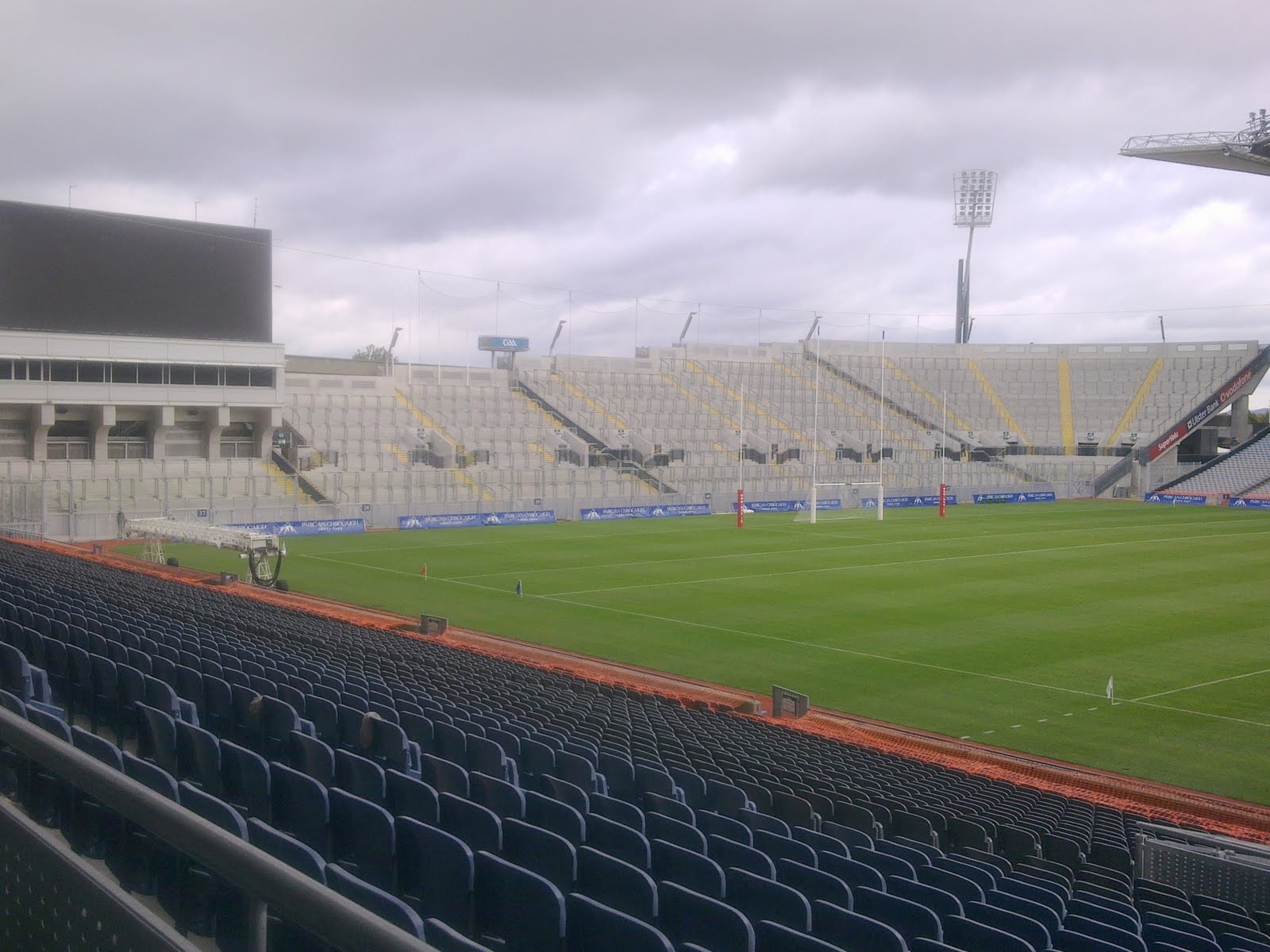
Croke Park (Dublin)


Croke Park in Dublin was first used in 1884 as an athletics and sports ground, known as both The City and Suburban Racecourse and Jones Road. The ground was the first home of Bohemian FC.

The site quickly became a prominent venue for GAA sports and in 1896 it staged both All Ireland Finals for the first time. It also staged the IFA Cup Final of 1901 between Cliftonville and Freebooters.

In 1908 a journalest and GAA member Frank Dineen borrowed some money so he could buy the Jones Road site from owner Maurice Butterly for £3,250. In turn Dineen sold it on to the GAA for £3,500 five years later. The GAA immediately called the ground Croke Park after Archbishop Thomas Croke who was one of the associations' first patrons.

In 1913 Croke Park had two stands on the Jones Road side with grass banking around the rest of the arena. In 1916 rubble from the Easter Rising was put at the Railway End to form Hill 16 (which was also called Hill 60 because it was sixty metres high).

November 21st 1920 saw a tragic event at the stadium which would sour Anglo Irish relationships for many years. It was at the time of the Irish War of Independence and that morning the IRA murdered a gang of British undercover agents living and working in Dublin. The Royal Irish Constabulary along with the British Auxiliary Division went to Croke Park where Dublin were taking on Tipperary in a Gaelic Football match and where the forces thought the perpetrators of that mornings attack would be. They enclosed the ground and arrested many as well as firing indiscriminately into the crowd. Fourteen men were killed. Thirteen were spectators, with the other being Michael Hogan, the captain of the Tipperary team. The day became known as Bloody Sunday.


During the 1920's the GAA set about making Croker as many locals call it, into a high capacity stadium. In 1924 The Hogan Stand was constructed on the Jones Road side and three years later the Cusack Stand (named after Michael Cusack of Clare who was the founder of the GAA) was erected opposite. In 1952 The Nally Stand was built next to Hill 16 after Pat Nally, another founder of the GAA. In 1961 90,556 set a Croke Park attendance record at the Offaly against Down All Ireland Senior Football Final.

During the 1980's the GAA looked for ways to increase the capacity of the old stadium. By 1991 it stood at 80,000 but the association wanted an arena to serve modern demands and giving patrons a good view around the large pitch required for GAA sports.

A new Cusack Stand was completed in 1995 at a cost of £35M on three tiers with a capacity of 25,000. The Davin Stand was built at the Canal End as an extension to the Cusack Stand from 1998 before phase three of the development, a new Hogan Stand including extra facilities for players and VIPs was carried out soon after. 


The final stage was built after the staging of the 2003 Paralympics and saw the redevelopment of the open end of the ground into a new Nally End/Dineen Hill 16 terrace. This end was kept as terracing to allow the sale of cheaper tickets, and it was divided into three sections. When Sean Kelly, the GAA President opened it in 2005, Croke Park was left with a capacity of 82,300.

In 2005 the GAA faced a dilemma. Lansdowne Road across the city was about to be rebuilt so the IRFU and the FAI required a venue to stage their games. However the GAA had strict rules in place. Up to the early 1970's the GAA banned anyone from playing in their sports who was found to also play football, rugby or cricket as Gaelic games were a symbol to Irish nationalism and promoted and maintained indigenous Irish sport. This rule was relaxed although GAA ground were not permitted to stage 'foreign' sports which could prove competition to the GAA organisation.


At the GAA Annual Congress in April 2005, it was agreed to temporarily relax rule 42 by a slim two thirds majority to allow the national rugby and football teams to play matches at Croker during Lansdowne Road's rebuild.

Floodlights were installed in 2007 to accommodate the stadiums' new teams with Ireland narrowly being defeated by France in the first ever Rugby Union match at the stadium on 11th February 2007. In the second game, England were visitors. There was nervous anticipation before the game owing to previous history and the Bloody Sunday connection, but 'God Save the Queen' was meticulously observed before Ireland gave the visitors a huge beating on the pitch.

On 24th March 2007 the Republic of Ireland defeated Wales in a Euro 2008 Qualifier with Stephen Ireland scoring the only goal, and the first at the ground for one hundred and six years. Matches for both the rugby and football sides continued at Croker until they moved back across the city to the newly opened Aviva Stadium in 2010.


My visit

Friday 15th October 2010

I was in Dublin for a few days sightseeing, socialising and visiting stadiums. On the Friday morning I had dragged my aching body (the Guinness around the city had been wonderful the night before!) to Drumcondra, Shelbourne, Home Farm and Sporting Fingal before it was time to get to Croke Park for a stadium tour.

The website advised me that tours were regular. I was a bit ahead time wise so I hoped I may get on a midday tour and then take a prolonged siesta to aid recovery before attending that evenings FAI Cup semi final at Dalymount Park. On arrival I was told there wasn't a tour until 1pm but I could pay and look around the museum for an hour. I'm very pleased that this was my only option.


The museum was superb, offering many displays about the GAA and the stadium's history. There was plenty to keep people of all ages entertained with audio visual and interactive activities. I had a really good delve before relaxing with a cuppa.

We were taken by our tour guide to the press room where he started talking in Gaelic, cue panic amongst the majority of us! He relented after offering us a warm welcome and reverted to English, not that it was much use to the group of Italians who continued to use their mobile phones and generally become irritants for the rest of the tour.

We kicked off with simply the best video presentation I've seen on my many stadium tours. It went behind the scenes and showed us a typical match day at the stadium including fans, staff, caterers, VIPs, Garda, players and officials. Our appetites whetted we went around to the Hogan Stand and went into the changing rooms and VIP areas before walking up the tunnel to go pitch side. Our guide was excellent and also very willing to answer any questions from the several Englishmen on board.

It was certainly an eye opener to myself and gave me a far greater understanding of Irish culture and their side of things. We were taking up to the top of the Davin Stand where we got a wonderful view of the city looking out of the back and an even better view of the stadium from the seats.

We returned to the starting point and shown the wall at the back of the Cusack Stand which had plaques for every registered GAA club, from all over the world, which was another surprise for me. I said my thank yous for a great tour before heading down the tunnel under Hill 16 where I got chatting to some Derby County fans who were equally impressed by the tour.

I told them about that evenings game when they spotted the distant floodlights at Dalymount and they seemed fairly interested. I went on my way down to O'Connell Street for some desperately required refueling before hitting the sack ahead of another amazing evening (see Bohemian page).


Croke Park was superb. A great stadium with a fascinating history we would all do well to remember but move on from. I hope to be back one day for a GAA match, and of course all the pre and post match socialising that goes with it!