Marlow FC are a non league football club who are based in the town historically known as Great Marlow on the banks of the River Thames, thirty three miles west of central London. Marlow were formed following a meeting at the Compleat Anhler Hotel on 22 November 1870, making them one of the older clubs in the country.'The Blues', as they were later nicknamed, entered the first ever FA Cup competition in 1872 and missed only an occasional season ever since. In 1882 they reached the semi finals of the competition before going down five nil to Old Etonians in the clash at The Oval.Marlow turned down turning professional and joining the Southern League in 1884 as Tottenham Hotspur took the place instead. Around this time the club were known as Great Marlow FC for a time. In 1908 the club joined the Spartan League where they lasted for three seasons before reverting to more local competition such as the Reading League and the Great Western Suburban League.

Marlow had played their football at Crown Meadow, but moved to Star Meadow in 1919. In 1928 they moved once again, this time to a ground at Oak Tree Road, which was named the Alfred Davis Memorial Ground after their long serving former secretary.The club rejoined the Spartan League the same year before moving to the Athenian League in 1965. When the league was disbanded in 1984 they became members of the bottom division of the Isthmian League. In 1987 promotion was sealed through a runners up league position. They followed that up by winning Division One the following season to become members of the Premier Division.Marlow enjoyed their greatest successes since their formative years in the early 1990's thanks to their feats in the FA Cup. In the 1991-92 season they reached Round One and a tie away to West Bromwich Albion. The match ended in a six nil defeat at The Hawthorns but it stimulated further runs.

The following season Marlow entered at the fourth qualifying round stage and saw off Sittingbourne, Salisbury City and VS Rugby before being drawn at home to Tottenham Hotspur in Round Three. The match was switched to White Hart Lane where The Blues were seen off five one, but left with many memories and a far healthier bank account!Plymouth Argyle put an end to a potential shock the next season at The Alfred Davis Memorial Ground in their first round clash, but 1994-95 saw another run to Round Three. Sutton United were seen off before Oxford United were defeated at home in a local derby. Woking also left Marlow beaten leading to a clash away to Swindon Town which ended in a two nil defeat.Sadly the team were relegated the same season and two years later The Blues went down yet another division. Owing to the restructuring of the non league pyramid Marlow were transferred over to the Southern League in 2004.From around the turn of the century, Marlow had been looking to develop a new facility and move out of their loved but aging venue. Flackwell Heath FC who are based south of High Wycombe and not far away form the north of Marlow were also investigating a move to a venue with better facilities to enable the development of their youth set up. Both clubs entered into talks around 2010 with thoughts of a shared venue at a suitable location.

The Blues were relegated at the end of the 2011-12 season down to the Hellenic League. However, the returned to the Southern League at the first time of asking.
Marlow FC will play in the Southern League Division One Central in the 2013-14 season.My visitMarlow 3 Rugby Town 5 (Saturday 5th November 2011) Southern League Division One Central (att: 121)
I had wanted to visit Marlow for some time, especially after reading the days of The Alfred Davis may have been numbered. I was on night shift and Scarborough Athletic were away in West Yorkshire, so I checked out the fixture list and grabbed my opportunity.

I was in decent form. The weather was mild and I'd had a decent sleep. When I heard the rain reports from Thackley, where the Boro were in action, I was greatly optimistic of a good result up there. You just sometime wake up like that! I put on my weekly charity donation to Paddy Power's benevolent fund and set out for Paddington. To my delight I found on arrival that trains were running on time and my service was virtually empty.Ater the familiar ride to Maidenhead, I changed train for the branch line to Marlow, and what a delight that turned out to be. After travelling through banked countryside, the line gave way to flatter land around Bourne End where we rode along the side of the Thames. It was a very well off area with smart bar and restaurants catering to the owners of the boats in the marina. Some stunning cottages were dotted along the banks. I would guess that the area hadn't seen many Labour MPs over the years!

I arrived at Marlow and headed straight for the ground. I missed out on the town centre, which was a bit of a shame if the example of the rest of the town was anything to go by. I would guess it would be an ideal early or late season midweek destination with a couple of hours free before kick off.It took me just less than fifteen minutes to arrive at the turnstile, where I paid £8 admission, plus an extra pound for what seemed like a steady programme. The ground looked just my cup of Earl Grey. Old and traditional. I headed straight for the clubhouse underneath the Main Stand.The bar seemed bereft of hand pumps or any bitter come to mention it. I asked the barman if there was any in stock. Things just got better. There was a pressurised container on the bar dispensing locally brewed Rebellion Ales. I handed over £2.90 for a majestic pint of Nutty Brown and took my seat to read the programme.


Something in the publication just wasn't right. I checked the Rugby line up against the pen portraits and they simply didn't match up. I went to look at the teamsheet that had just been pinned up by an official and the plot thickened. A kind local came up and told me I was wasting my time. Owing to what is known in the trade as a 'cock up', the Bedfont line up from the previous Tuesday night game was listed where the visitors from Rugby should have been. A confused young away fan asked behind the bar for a teamsheet to no avail. Apart from that it was a decent enough programme. A fan's article bemoaned Marlow's lack of luck when it came to recent refereeing decisions. Where have I heard that before? The editor apologised over the PA system before kick off, which I thought was a decent gesture. It got a few laughs.I went for a top up, but after a few drops the barrel ran out. A jacketed club official was assisting behind the bar and said there was no more! My jaw must have nearly hit the counter, before he broke into a smile and said, "But we have some IPA". It was yet another lovely brew. I so wished other clubs around the country would support the ever increasing list of local breweries, even if just in bottle form. It makes a visit to a poor game into a good day out.A couple of local characters sat on the table next to me and regaled me with tales of their past footballing and drinking exploits. One said he was trying to avoid the demon drink and mentioned how good my ale looked. I didn't want him feeling bad, so I supped up and headed outside for a look around the ground as the floodlights were turned on for the first time for the start of a 3pm kick off that season.
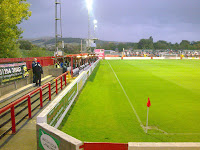
The Main Stand was a wonderful structure with white paintwork and a raised seating deck offering a great view of the action. A few steps of terracing ran at either side of it, with a flat standing area in front. I loved the 'no smoking' sign in the shape of a giant cigarette hanging from the roof! The Training Area End was just a few steps of open terracing with an all weather area behind it which doubled up as a car park for the match. The players facilities were in the corner by the turnstiles. The far side had terracing and grass with the NWE Enclosure in the centre offering shelter for standing spectators. A solitary bench sat in there as well to take the weight off anyone's tired feet. Another entrance and exit was in the corner before the final side, The Trinity Road End. This was a terracing with a cover in the middle. All in all The Alfred Davis Memorial Ground was a lovely venue, and one of my favourite.Rugby had brought maybe up to thirty fans with them from Warwickshire. Some stood behind the goal with an enormous St George Cross flag. The louder home fans went behind the other goal, also with some flags which hung from the back of the enclosure. These fans were called the Behind Both Goals Gang.'Sports' as Rugby are nicknamed went one up through a free kick after sixteen minutes. By now I was jubilantly sending second hand texts to my Boro mates as they were three nil up at Thackley. Marlow were decent enough going forward, but their defence was in extremely generous mood. A second visitors goal went in after fourty minutes which saw around six or seven away fans behind the goal replicate the newest of fads, The Poznan. This act gets on my nerves when done at Eastlands, but today it was funny watching the happy fans as they sang along. They were at it again just before half time as the locals groaned one again as their defence sprang another leak. I went downstairs to the clubhouse. All was good. The game was entertaining, Boro had gone four nil up and England had taken the lead against Australia at Wembley in the Rugby League. I had a look around the room at the lovely array of old pictures and posters of past glories. The Plymouth Argyle cup tie had featured on Match of the Day with John Motson covering the game as commentator. Motty's signed information sheet that he used on the day was framed on the wall. It was hungry work taking all this joy in, so I celebrated by tucking into a huge and very tasty bacon cheeseburger.Yet another defensive error saw the Marlow rearguard offer a clear run on goal, with Sports going four up. The game got a little feisty at times with challenges flying in on the bobbly surface. I thought the referee coped admirably. Eventually the home side pulled a deserved goal back. Within seconds Rugby went up the other end and added another as a forward headed home as the back four played statues. In fairness The Blues never gave up. On the evidence of the afternoon I would surmise that they would always score goals, but the defence needed sorting out rapidly. They pulled another goal back with fifteen minutes remaining. It was nice to see the away fans celebrate the goal with their dance routine!There were more chances as the game reminded me of one of those goalie when needed matches I used to play in as a kid. Both sides really went for it. It was brilliant for a neutral. Marlow grabbed another through a brilliant header on full time, but it was too little, too late. I had applauded their goals on the day as I took a liking to them, both for the ground and the fact that their Supporters Trust were their shirt sponsors.

I headed out as the game entered injury time to get to the station for the 5.06 train. The way the match went I wouldn't have been shocked to log onto the Southern League website to find out I'd missed another couple of goals.I had a nap on the trains back to the metropolis, where hoards were heading home from their particular games. I bet no-one had as good a collective day as me, especially as Boro ended up winning five nil!
Padiham FC are a non league club who were formed in 1878 and are based in the small town about three miles west of Burnley, which was once a player in the industrial revolution but is now a conservation area. The club were popular when formed, once attracting a crowd of 9,000 for a fixture against Burnley in 1884 to their ground by the banks of the River Calder. It is because of the grounds' location that the club are nicknamed 'The Caldersiders' as well as 'The Storks'.The club folded in 1916 as it struggled to compete with professional clubs from larger nearby towns. During this time, Padiham lost their ground and as a consequence they didn't reform until after the end of World War Two.

They moved into the Arbories Memorial Sports Ground with a gate of 1,777 turning up to see their first league match in the Lancashire Combination. In 1982 Padiham became founder members of the North West Counties League, where they remained until 1990 when they had a spell in the West Lancashire League.They returned to the higher grade in 2000 and gradually improved before winning promotion to the top tier in 2008. Steve Wilkes outfit were crowned champions of the NWCL in 2012-13 and were promoted to the Northern Premier League for the first time.

Padiham FC will play in the NorthernPremier League Division One North for the 2013-14 season.My visitWednesday 14th September 2011
I was in East Lancashire for the day before heading to Manchester for the evening. I had visited Accrington Stanley the previous night for their game with Rotherham United and had spent the morning in the undulating landscape visiting Nelson and Colne and their football grounds. I had just left Burnley, having been given a look around Turf Moor and then caught a bus for the short journey to the picturesque town of Padiham.I was a few minutes ahead of schedule and wondered whether to rush and catch an earlier bus or relax and maybe even have a quick half before continuing to Blackburn. I walked though the hilly town, climbing all the time until I reached the signs for the football and cricket clubs, which I knew were located next to each other. I wandered past the tempting Hare and Hounds pub, up a small lane to the ground. Straight ahead up a few steps was the cricket club and to the right the football ground. Thankfully the gate was open.

A couple of gents were coming off the pitch, one of whom was club secretary Alan Smith. I asked for permission to take some photos and I explained to the older of the two what I was up to. The Arbories Memorial Ground really was a neat and looked after venue. The club rooms and changing rooms were along the near side. A seted stand straddled the half way line with a cover for standing spectators towards the far end. Behind that goal was just a narrow piece of flat open hard standing. The far touchline was dominated by a grass bank with narrow hard standing at the front. The end bordering the cricket ground had a cover towards the far side and a few steps of terrace, which ran the full goal line. Alan kindly brought me out a match programme to take with me and had a very interesting chat about Padiham and non league football in general. I was amazed to hear that Padiahm FC were the only club in the town to field senior football sides on a Saturday. Some of Alan's stories about the hard work going into running a club at this level was familiar to tales I hear around the circuit. It was really nice to hear that Padiham were very much a community club who endeavoured to help others wherever possible.

I went on my way and within minutes a bus arrived to take me onto my next venue, Ewood Park. Different facilities and crowd figures but all part of the same wonderful game. If only all the larger clubs could remember that at times!
Work first began on the new Wembley Stadium in 2003 to replace the famous old venue that had seen so many wonderful days and held so many happy memories to so many.The initial plan was for the old stadium to be demolished in 2000 with new one being ready for 2003, but a series of financial and legal battles delayed things.

The stadium was designed by HOK Sport, which included the work of Sir Norman Foster with engineers Mott MacDonald and was built by Australian company Brookfield Multiplex. The stadium was funded by Sport England, Wembley National Stadium Ltd, the FA, The Government Department for Media Culture and Sport and The London Development Agency.Originally it was proposed that the stadium would also be able to stage athletics, but after many hearings and consultations, this was vetoed. In 2004 Brent Council unveiled plans to regenerate the whole area into a new Wembley City. The Wembley Conference Centre and multi storey car park was demolished and the Arena was upgraded.

Delays during construction were caused through disputes over the arch as well as contractual and safety issues. Opening dates were put back on several occasions, much to the embarassment of the FA and Minister for Sport, Richard Caborn.The stadium was handed over to the FA on the 9th March 2007. Residents of the Borough of Brent were admitted to a test event on Saturday 17th March with England Under 21s playing a game with a reduced capacity to satisfy the safety certificates.

A statue of Bobby Moore was unveiled on Friday 11th May overlooking th stadium approach with the FA Trophy Final between Stevenage Borough and Kidderminster Harriers being played the following day. before Wembley Stadium was officially opened on Saturday 19th May 2007 for the FA Cup Final, which saw Chelsea defeat Manchester United 1-0 with a Didier Drogba goal.
The first full international at the new stadium saw a 1-1 draw between England and Brazil on the 1st June 2007. Germany became the first foreign national side to defeat England there the following August. The stadium became home to the Football League Play Off Finals and FA Cup semi finals, The League Cup Final, FA Trophy Final, FA Vase Final as well as all full England internationalgames.As well as football Wembley also began to host an annual regular season NFL (American football) match and an annual motor festival as well as many music concerts.

In 2011 the stadium was chosen as venue for the Champions League Final between FC Barcelona and Manchester United. Barca put on such an incredible display that it was felt that it could take many years before it was bettered. The 2013 final of the same competition will return to Wembley, such was the previous staging so successful.To read a full stadium description, go to the page on Wembley Stadium (new) My Visits.
The current Accrington Stanley FC are the second club to carry this famous name from the textile town in East Lancashire. The legend starts way back when the original club of Accrington FC were formed following a meeting in a local public house in 1876.'The Owd Reds' played at Thorneyholme Road, the home of Accrington Cricket Club and became one of the twelve founder members of the Football League in 1888. In their third season they finished sixth in the table, but their spell didn't last long. They were relegated in 1893 and rather than play in the League's Second Division, they resigned and played non league football. Financial troubles hit the club as they continued, but in 1896 the club folded after a 12-0 defeat to Darwen in the Lancashire Cup.

A team called Stanley Villa, because they were based at the Stanley Arms pub in Stanley Street, changed their name to Accrington Stanley in 1896 and joined the Lancashire Combination. They reformed in 1921 and joined the Football League's new Division Three North, playing home games at Peel Park. Stanley finished runners up in that division on a couple of occasions in 50's, but only one side were promoted to the second tier at that time. Persistent financial troubles were a constant around this time and were not helped by the building of a new Burnley Road Stand in 1960. On 12 February 1962 Edwin Slinger, the chairman resigned from his post as he revealed the club owed up to £8,000. He persuaded the other directors to also resign as he worked to get the Burnley chairman Bob Lord involved in buying their shares and saving the club.

Peel Park in 2011 above
Stanley lost 4-0 away to Crewe Alexandra on 2nd March 1962 and a couple of days later it was revealed that the club also had a further £40,000 of unsecured creditors. Lord and Sam Pilkington, a driving force of the club, decided enough was enough so they tendered the clubs' resignation to the Football League. Their secretary Alan Hardaker accepted so Stanley left the League on 11th March with their results expunged.Stanley continued at Peel Park for four seasons in the Lancashire Combination before they called it a day with dwindling attendances and large debts.In 1968 a meeting at the town library led by Stanley Wotherington began the revival and the rebirth of Stanley. By 1970 they had found a new home, The Crown Ground on Whalley Road behind The Crown pub with their first match against Formby saw 620 fans attending in the Lancashire Combination. A few games were played at Peel Park, owing to the poor pitch at The Crown, but a full time return was not to be.In 1982 Stanley became founder members of the North West Counties League as a sizeable amount of money was spent on their pitch. Around this time the club found fame through a Milk Marketing Board advert. To view it, click below:www.youtube.com/watch?v=pieK7b4KLL4In 1985 floodlights were installed as the club moved into the newly formed second tier of the Northern Premier League. By 1991 they were in the Premier Division following the resignation of South Liverpool as attendances grew.In 1994 Eric Whalley who had a previous spell at Stanley, returned first as team boss and then general manager to move the club forward. The ground was continually improved and in 1997 Stanley received a huge boost with the transfer of Brett Ormerod to Blackpool for £50,000. After a few managers tried to push Stanley on to the next level, Liverpudlian school teacher John Coleman was appointed after they suffered their first ever relegation.
Coleman succeeded in his first season and began to introduce many youngsters into the side as crowds continued to improve along with the development of the Crown Ground. In 2003 they lifted the Northern Premier League title to join the Football Conference. In their first season they reached the FA Cup third round before going down to Colchester United after a replay. The team consolidated in the league until the 2005-06 season saw Stanley run away with the championship, with League football returning to the town after a gap of forty four years.On its return to the League there were some memorable occasions for the club such as defeating Nottingham Forest at the Crown Ground in the League Cup, but generally the team struggled initially. Coleman's side gradually found their feet with more youngsters getting their opportunity, some of which had been released from larger clubs and some coming through the clubs' youth system.Stanley were defeated in the 2010-11 play off semi finals by Stevenage Borough. In January the following season Coleman left the club as more promising players were sold to make ends meet. Paul Cook and then Leam Richardson had spells in charge of team affairs, before James Beattie took over in the summer of 2013.Accrington Stanley FC will compete in Football League Two in the season 2013-14.My visitAccrington Stanley 1 Rotherham United 1 (Tuesday 13th September 2011) Football League Two (att: 1,486)
I had a couple of days off work after my night shifts so I decided to plan an expedition away from London. After checking out the fixture list and the cost of trains and hotels I plumped to head to East Lancashire. The plan was to go to watch Stanley, visit clubs in the area during the day on Wednesday and then find a game that evening, with Manchester City v Napoli my preferred choice.

I arrived in Accrington around 5.30pm after changing trains from London at Preston and set out to see some of the town. I was staying in Burnley that evening, but rather than book in first and return to the game, I wanted to visit the site of Peel Park in daylight. It quickly became obvious that the town centre was in a dip as I climbed through the many similar terraced streets, including Stanley Street where I went past the Stanley Working Men's Club. A few minutes later I was in Turkey Street behind where the Main Stand once stood.


It was a wierd feeling, despite there being no real evidence that there was ever a decent sized stadium there, although the shape remained. A pitch was marked out so the signs were it still got used on occasions. I retired to the Peel Park Hotel for a top class pint of Tetley's and enjoyed a warm welcome and the assorted sporting memoribilia adorning the walls. The locals were in full conversation about the issues of the day in that lovely rich local dialect.I set off to find the Crown Ground using my pre printed map. En route I came across a sign for Accrington Cricket Club, the home of David 'Bumble' Lloyd and where Shane Warne was a young club professional once upon a time. I went down the path at the end of Thorneyholme Road for a quick look and to take a couple of photos.I continued through the post war housing estate and soon found myself on Livingstone Road by the stadium entrance, just as a coach full of Rotherham fans and their team coach arrived. I bought a programme from the young seller who asked me as to the form of The Millers. I explained I was a Scarborough Athletic fan there to watch Stanley. He seemed overjoyed at the news and hoped I enjoyed the game. It's little things such as this that make the day out that bit more special and more was to come.

Some steps behind the stand led up to the clubs' own pub, The Crown. I was aware in advance that they didn't have handpumps on, but I made do with Newcastle Brown. It was a smashing pub with plentiful helpful staff and lots of seating, plus the football club got the money. Even better, it served warm pies! I programme from a 1949 clash between Hull City and Stanley at Boothferry Park caught my eye, along with lots of other Stanley mementos. Pennants and scarves of some visiting clubs were also on display.I got chatting to some knowledgeable away fans about all manner of the game and then some very dry local gents who were a comedy show waiting to happen in between passing on their views of the club.I went past the programme seller who said hello once again and paid my £16 for the home end. The Crown Ground was not the greatest venue ever to stage League football, but has obviously been built when finances have allowed. I was in the Walley Road or Sophia Kahn Stand. This was originally an open terrace before a roof was added, and then seats at the front to meet regulations. Tpo the right there's the main seating, which looks like one stand but is actually two (the Main and Thwaites Stands), with a roof joining them. The seats are cleverly angled to give patrons the best possible view. The away fans were on the far open Coppice Terrace with the players entrance in the corner. The final side was the narrow Whinney Hill Stand, which also had seats fitted to comply with League standards, with open terracing either side.


Rotherham looked the better side throughout the first half without finding a breakthrough. The bloke in front of me was nearly bursting with his constant advice of "make a tackle McIntyre" aimed at the nervy Stanley full back, and "you are a clown liner" towards the near side linesman or assistant referee as they became ludicrously titled. Everyone gave 100% support to their side in my section. Men, women and children gave it their all. A drummer banged away constantly with the singers around him attempted to raise their troops.Just before half time United took the lead when skipper Ryan Cresswell headed home unmarked from a corner. I decided to beat the rush and enjoyed a 'meat n tatie pie and a bovril as the aftermath of Hurricane Katrina's continued to whirl around the hills.Rotherham continued to boss but gradually the tide changed. Roared on attacking our end Stanley, with their mix of loanees, free transfers and kids iled forward. They got more and more of the ball and began to pressurise the defenders. I had to laugh when a bloke beside me gave the 'liner' and all the opposition players real hell in a rich local accent. I turned to see a man I would have marked down as Indian!

The home side got a free kick about twenty five yards out with seven minutes remaining. Veteran Sean Hessey got permission to take the kick quickly from the referee and while Rotherham were lining up a wall and generally wasting time the ball was plonked into the bottom corner of the net, much to the annoyance and protests of the South Yorkshiremen.Stanley continued top press but couldn't find a winner, while United also missed a late sitter. A draw was just about the right result.I walked back down into town in time for the 10pm train to Burnley Central where I checked into the low budget but friendly Keirby Park Hotel and enjoy a couple of pints in The Boot to read the programme and reflect on my visit.I have heard and read of football fans who have no time for Stanley. They claim they've pinched a history that isn't there's and get by with a romantic notion about themselves. They say they shouldn't be allowed in the League with their ground and lack of finances, and that the loyal John Coleman's teams are a bunch of cloggers who play horrible football. Well I must disagree vehemently.Fans maketh a football club. There are still fans at The Crown who were at Peel Park. They kept the flame alive in the same way fans of Scarborough Athletic, AFC Wimbledon, Berkhamsted and many more clubs fans continued to promote football in their respective towns. It's how the fans feel that matters and not someone with no connection with the club. Stanley fans are some of the friendliest, loyalist and most partisan I've ever come across. It's just there's not many of them, but who knows in time? Maybe if Blackburn or Burnley have slumps, the locals, especially the touth of tomorrow will choose their local club?

The Crown was no Old Trafford, but it met every criteria demanded by the Football League andJohn Coleman consistently continued to produce a competitive team on a ridiculously low budget, giving many youngsters a further opportunity to move to bigger clubs and progress.Good luck to Accrington Stanley and all of its supporters. I had a lovely time and wish them well.


