Sunday, February 3, 2013

Linlithgow Rose


Linlihgow Rose FC are a Scottish junior (non league) football club from the town of Linlithgow West Lothian, which is located twenty miles west of Edinburgh. Linlithgow is a commuter town with history, being the birthplace of Mary, Queen of Scots. Linlithgow Palace was once one of the most prominent royal residences in northern Europe.


Rose were formed in 1889 the well supported club moved into their Prestonfield home in 1949 as they won several trophies and were crowned the champions of the Edinburgh & District League on several occasions, with the first title coming in the 1964-65 season. Rose crowned a fine season by also winning the Scottish Junior Cup as Ballieston Juniors were beaten 4-1. They returned to Hampden Park in 1974, but on that occasion Cambuslang Rangers proved too strong.

The 1974-75 season saw the first of nine SJFA East Region titles arrive at Prestonfield. The final win came in 2001-02, which was also the same campaign that saw a second Junior Cup being lifted after Auchinleck Talbot were beaten. Linlithgow returned to the final the following season going down by an only goal to Tayport.


After re-organisation Rose were placed in the SJFA East Region Super League, where they were crowned champions for the 2003-04 season. A further title came in 2006-07 and for a third time the team completed the double with the Junior Cup win coming against Kelty Hearts. As a result of the win and a change of policy from the Scottish FA, Rose were allowed to compete in the Scottish Cup the following season. They reached the fourth round where they they went out to eventual finalists Queen of the South.

Successful manager Jim Sinnett resigned in 2008 after a successful time at the club before Linlithgow went on to win the 2010 Junior Cup Final, beating Largs Thistle in the final with a goal from Kevin Donnelly and Dave Baikie as manager. Mark Bradley replaced Baikie in December 2011, leading the side to a third place league finish at the end of the 2011-12 season.

Rose reached the Junior Cup Final in 2013, but were defeated by Auchinleck Talbot at Livingston.

Linlithgow Rose FC will play in the SJFA East Region Super League in the 2013-14 season.


My visit

Tuesday 29th January 2013

Ideally I try to watch games on as many new grounds as I can, but time, distance and money means that it would mean I would go without seeing some really excellent venues. Therefore, when I have spare time and/or I'm visiting a new places I try to get to see new towns and football clubs and broaden my knowledge.

It was on such an occasion that my Dad was held up to join me in Edinburgh, so rather than wasting an opportunity I planned a day of groundhopping around the capital before heading out into West Lothian on the train.


Unfortunately the weather wasn't the best, with heavy showers coming down at regular intervals. This was a shame as Linlithgow High Street looked to be very nice and the conditions didn't really do it justice. It was definitely not short of pubs, as I counted nine! I continued past Linlithgow Cross, up the hill to Preston Road where another steep slope and bridge over the railway took me to Braehead Road, where the club was to be found.

It was just gone 1pm so the kids from the academy just down from the ground were streaming out. The gates to Prestonfield were shut, but I still managed to see over the wall and at the far end to get some snaps of a most impressive venue.

The Clubhouse End was flat open standing in front of the wall. The near side had terracing and a cover over the centre section. Opposite was a lovely raised seated stand with some open standing either side, with grass banking behind the final goal completing the scene.


On completion of my task I headed back to West Port, which was a continuation of High Street to check out if there was an earlier bus to my final port of call for the day, the home of Bo'ness United. As none were forthcoming I walked down into town to the Cross past Linlithgow Loch to take in a view of Linlithgow Palace.

All in all I was impressed with the town and the football ground and was glad I'd made the effort to go for a look.


Heart of Midlothian


Heart of Midlothian FC are a Scottish football club from the Gorgie district of Edinburgh who were formed in 1874. The club. who are commonly known as Hearts, were formed by a group of friends who saw the first association game played in Edinburgh who named their new club after the prison on the Royal Mile, which had been demolished fifty seven years previously.


The team began life playing at East Meadows, with Tom Purdie the clubs first captain. After spells playing at Powburn and then Powderhall, Hearts moved across the city to Gorgie, playing at a ground where Wardlaw Street now stands. Five years later they moved into Tynecastle Park across Gorgie Road. Hearts became founder members of the Scottish Football League for the 1890-91 season. It was memorable for the club as 'The Jam Tarts' or 'Jambos' to give the club two of its nicknames lifted the Scottish Cup, defeating Dumbarton 1-0 at Hampden Park at the end of the campaign.

Hearts were crowned league champions in 1894-95, going on to win the Cup the following year, this time with a 3-1 win over their biggest rivals Hibernian (Hibs) at St Bernard's Logie Green home ground in Edinburgh in the only final to have been staged outside Glasgow. A second league title was secured in 1896-97 as well as Hearts also completing a couple more Cup victories in 1901 and 1906 as Celtic were defeated 4-3 at Ibrox and then Third Lanark were seen off at the same venue.


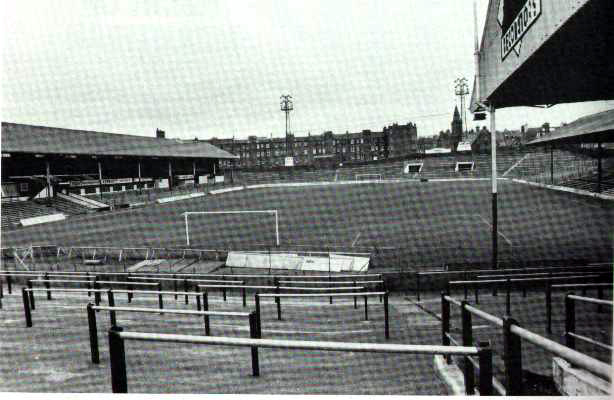
Tynecastle before redevelopmnet
taken from the internet
In November 1914 Hearts were comfortably leading the First Division when politician George McCrae formed the voluntary 16th Battalion the Royal Scots to fight for King and Country. Sixteen first team players plus five hundred fans enlisted. Seven players; Duncan Currie, John Allan, James Boyd, Tom Gracie, Ernest Ellis, James Speedie and Harry Wattie lost their lives.

The club went forty eight years without a major honour, but under manager Tommy Walker success came in droves. The League Cup was lifted in 1954, 1958 and 1959 and 1962. In 1956 Celtic were beaten 3-1 in the Scottish Cup Final and the team won two league titles in 1957-58 and 1959-60 with players such as Alfie Conn snr, Willie Bauld, Jimmy Wardhaugh, John Cumming, Alex Young and Dave Mackay. In 1964-64 with some of the stars moved on they lost the final game 2-0 to Kilmarnock to lose the title on goal average.


The team went into decline for several years although some joy was spread with the performances of Donald Ford, Jim Cruickshank and Drew Busby. The Jambos were placed in the Scottish Premier League upon its introduction in 1975, but they were consequently relegated and then promoted on three separate occasions. The board of directors eventually resigned after the final spell at the lower grade to be replaced by new owner Wallace Mercer, who quickly oversaw a vast improvement.

In 1985-86 Hearts were seven minutes from being crowned league champions once more as they only needed a draw from their final game, but two Albert Kidd goals for Dundee and a heavy Celtic win at St Mirren meant heartbreak for all at Tynecastle. In 1990 Mercer unveiled a plan to merge Hearts and Hibs to try and break the Glasgow old firm monopoly, but he was knocked back in his attempts by shareholders refusing to deal. The early 90's saw Tommy McLean, Joe Jordan and Sandy Clark all try but fail to satisfy Mercer in the managers seat before he sold up in 1994. Jim Jeffries side lifted the Scottish Cup in 1998 with a win over Rangers before Craig Levein and then the legendary former player and record goalscorer John Robertson had spells in charge of the team.


In 2004 the club CEO of the time Chris Robinson announced that Tynecastle was not fit for purpose and that the ground needed to be sold to pay off the clubs debts, while Hearts would move into Murrayfield, despite the Tynecastle having being redeveloped ten years previously. The move was blocked helped by a campaign called Save Our Hearts. In August of the same year the Russian-Lithuanian multi millionaire Vladimir Romanov entered into talks into buying the club.

Romanov made himself immediately popular by stating that the club could become viable by remaining at Tynecastle. He bought up shares from Robinson and other major shareholders, although his manner of controlling the debts caused concern as they were moved from the their previous banks into institutions owned by Romanov. George Burley was the first manager of the new era and his side won their first eight games before Romanov shocked the football world by sacking him! Managers came and went and Romanov sacked a respected CEO, which led to an advisor resigning. He replaced them both with his son Roman Romanov.

Nine permanent managers were sacked in the space of just seven years as several players came in on loan from FBK Kaunas of Lithuania who Romanov also owned. Financial problems continued to blight the club despite regular appearances in European competition. In November 2011 the club was put up for sale as the players wages weren't paid. Eventually after several threats the players received their remunerations. The setbacks failed to dampen the spirit of the squad who went on to win the Scottish Cup in 2012 with a 5-1 hammering of Hibs at Hampden Park under boss Paulo Sergio.


Sergio rejected a new contract so former coach John McGlynn was recruited from Raith Rovers with a very strict budget and orders to bring through the youth players. Again the club were hit with transfer sanctions for the first part of the 2012-13 season and in November 2012 Hearts were issued with a winding up order by the Court of Session in Edinburgh for failing to pay an outstanding tax bill. It was agreed to pay the bill in two installments as a new share issue was launched and fans were asked to help save the club as it announced that it would look towards supporter ownership in 2013, as Hearts became just one of many clubs who suffered by the none presence of Rangers in the SPL.

The clubs future was in real doubt throughout the summer of 2013 as they entered administration and were deducted fifteen points going into the 2013-14 season. All players were put up for sale as a buyer was desperately sought.

Heart of Midlothian FC will play in the Scottish Premier League in the 2013-14 season.


My visits

Tuesday 29th January 2013

As I was only a mile or so away from Tynecastle after visiting several clubs and their grounds around Edinburgh I decided that it would be a good idea to go to the ground and to purchase tickets for Dad and I for the match the following evening.

I jumped off the bus and went behind the Main Stand, where I saw a gate open with steps leading up to a stand. I went inside and took some photos while taking in the surroundings as a group of youngsters were by the players tunnel as they were given a tour.


I was in The Gorgie Stand, which was a single tier of seats, divided by a middle walkway. Before its erection there was an open terracing with tenements forming a familiar backdrop behind. At the far end stood The Roseburn Stand, which was virtually the same as the one I stood in, as was The Wheatfield Stand down the left hand touchline. The stands roofs joined in the corners, where the floodlights were positioned, with screen ends enclosing the arena. The final side was taken up by the Archibald Leitch designed Main Stand. This had seating placed on the old terrace paddock and seating behind the dividing wall. It was much smaller than the newer additions, but it added a touch of tradition to proceedings.

After taking a few photos I returned to the ticket office and megastore, where I paid £24 for myself and £18 for Dad for the next days game. Satisfied with my work I jumped on a bus to Haymarket, where I was to catch a train to Linlithgow to tick off another couple of non league venues.

Heart of Midlothian 1 Dundee 0 (Wednesday 30th January 2013) Scottish Premier League (att: 11.284)


Not for the first time, Dad and I had done a marathon walk in a city. This time we just about covered both Edinburgh's old and new towns as well as a walk through Leith to Ocean Terminal before going back to our hotel for a much needed rest before the evenings entertainment. Amazingly a short nap had revived us as we walked to the Standing Order on George Street for some food. We felt good and we were a little early so we decided to walk down to Tynecastle.


Of course the spare time needed filling, so on a recommendation we walked up Henderson Terrace and entered The Athletic Arms, which is probably better known as The Diggers as it's over the road from Dalry Cemetery. It proved to be a good selection as the immaculately attired barstaff looked after the growing crowd in a splendid pub serving fine ales and good value snacks. Much of the walls was filled with Hearts memorabilia including a fine gallery of former heroes in the small room off the main bar. We headed back down the hill and went into the Tynecastle Arms for a half and a wee dram. The pub didn't hit the same standards in some respects, but was still a good pre match choice.


At just gone 7.30 we went into the ground next door to the pub and climbed the steep steps up The Gorgie Stand. After I'd picked seats in the wrong block we soon found our correct positions. The view was astonishing. Neither of us had ever been in such a steep stand. We were on the back row, yet we looked down on the goal.

We quickly realised why Dundee were adrift at the bottom of the table. They were not very good and looked more than happy to leave town with a point as they continually got behind the ball and only occasionally crossed the half way line. Hearts played some nice stuff, but they were not deliberate enough. Many a time they had a shooting opportunity and to swing in a cross, yet they often looked for one or two passes too many.

Hearts had a couple of loan signings from Liverpool after their transfer embargo had been lifted; Michael Ngoo and Danny Wilson. We only realised this on later reading the programme and then had a good laugh as Mr Ngoo while very capable of holding the ball up and bringing others into play, also looked incapable of shooting except in the exact direction he was facing. He had a couple of attempts and somehow hit the bar with one effort.


At half time we went downstairs onto the adequate concourse to stretch and get the blood flowing as well as catching up with the half time scores. I decided to have a pie and a bovril, but gave up after ten minutes of standing in the slowest queue I'd found all season, while the other lanes sped by. I hoped the bonnie wee lass behind the counter could find something not requiring much energy in later life.

The second half continued in the same vein as the first. Hearts had all the ball, but couldn't find a way through despite Jamie Walker's trickery. The visiting bar was rattled with a long range shot, but with time running out we thought we'd drawn a blank. With six minutes remaining the home boss John McGlynn decided to introduce the experienced John Sutton up front and wide man Arvydas Novikovas. The decisions paid off almost immediately as the Lithuanian held his position rather than chasing the ball like so many others on parade and was fed down the left. He produced a fine cross to the back post, where Sutton launched himself to head past Rab Douglas in the Dundee net.


Douglas pulled off a wonder save in stoppage time as Hearts looked like scoring at will. Sutton won more in the air in his brief cameo than Ngoo had done all night. The locals were naturally delighted at full time. They'd been through some hard times but they still cheered their side on.

We waited to get out and then got a good walk going again, finding ourselves back in the pub a couple of miles away at around 10.15. It had been a good experience in a wonderful football ground, which although modern had remained in the heart of its traditional community, rather than than the club decamping to a soulless out of town development.

To round off a top day my goals galore bet came in thanks to the shambolic Chelsea defence at Reading!


Hibernian


Hibernian FC, or Hibs as they are commonly known, are a Scottish football club based in Leith in the north of the capital Edinburgh. The club were formed in 1875 by Irish immigrants in the Cowgate area of the city, with the name of the club derived from Hibernia which was the Roman name for Ireland.

Because of their background there was some sectarian resistance to Hibs competing in Scottish football. In 1887 the club lifted the Scottish Cup after defeating Dumbarton at the second Hampden Park, which would later become Cathkin Park; the home of Third Lanark. Hibs defeated Preston North End following this in a game that was billed at the time as the World Decider.


Unfortunately bad management at the club led to it losing its home ground as it ceased to operate in 1891. The following year a reformed club acquired a new ground in Leith that was to be known as Easter Road, despite it being located on Albion Place. In 1893 Hibs were elected to the Scottish Football League, reaching the First Division in 1895. At the same time the club passed a rule that players no longer needed to be members of the Catholic Young Men's Society.

In 1896 the club were defeated in the only Scottish Cup Final to be played outside Glasgow, as their arch rivals Heart of Midlothian triumphed at Logie Green in Edinburgh. Hibs lifted the Cup once again in 1902 when Celtic were beaten on their home ground. Little did 'Hibees' fans realise that it would be the last Cup triumph for over a hundred years. In 1902-03 the club were crowned as champions of Scotland before they were lost out in the Cup finals of 1914, 1923 and 1924; the first two to Celtic and then Airdrieonians.

The period after World War Two was one of the most successful in the clubs history as they became one of Britains foremost clubs. The 'Famous Five' forward line of Willie Ormond, Bobby Johnstone, Eddie Turnbull, Gordon Smith and Lawrie Reilly all scored over one hundred goals for the club. Only Ormond cost a fee, coming in from Stenhousemuir, while the others all came from youth or junior football. Along with the likes of Bobby Combe and Eric Younger the team won the league in 1947-48, 1950-51 and 1951-52, as well as finishing runners up on another couple of occasions.


Hibs became the first British club to play in European competition in 1955 as Chelsea were deterred from entering the European Cup. The Hibees reached the semi final stage where they were defeated by Stade Reims. The club also had some decent runs in the Inter City Fairs Cup in the 60's with Napoli and Barcelona amongst their scalps.

Eddie Turnbull returned as manager in 1971 and produced a side labelled 'Turnbull's Tornadoes'. They lifted the League Cup in 1972 and inflicted a 7-0 win over Hearts at Tynecastle the following year. The team ended runners up in the League in 1973-74 and 1974-75 with Peter Cormack, Peter Marinello and Pat Stanton being amongst those starring. Turnbull went by the end of the decade with Hibs relegated, although they returned to the top flight in 1980.

The team failed to qualify for Europe for nine further seasons despite a few appearances from George Best along the way. Owing to mismanagement during the fallow years, Hibs were close to bankruptcy in 1990 at which point Hearts owner Wallace Mercer tried to merge the two clubs. The fans set up a Hands Off Hibs campaign, convincing Kwik Fit owner Sir Tom Farmer to buy a controlling interest in the club despite having no interest in football. A year later Hibs won the League Cup with a win over Dunfermline Athletic.


Two views of Easter Road in the 80's
pics courtesy of Gary Griffiths

Alex McLeish was appointed as manager in 1998, but the team were relegated. However, they returned to the Premier League a year after. 2001 saw another defeat in the Scottish Cup Final as Celtic won 3-0 with McLeish moving to Rangers soon after. Player Franck Sauzee had a disastrous spell in charge before Bobby Williamson was brought in. While he was unpopular with fans, youngsters such as Derek Riordon, Scott Brown, Kevin Thomson and Garry O'Connor got their opportunity.

Wiiliamson moved on to be replaced by Tony Mowbray who was popular with the style of play he employed. He stayed for three years before his talents were courted elsewhere, so Hibs employed former player John Collins in his place. Collins led the team to lift the 2007 League Cup but left after he was  refused funds to strengthen the squad. Another former player Mixu Paatelainen had a spell at the helm before yet another ex Hibee John Hughes took over. He was given funds to buy Liam Miller and Anthony Stokes as the team qualified for the Europa League for the 2010-11 season. 

However, after a poor start and a first round elimination Hughes was sacked to be replaced by Colin Calderwood, who himself lasted just over a year in the hot seat. Pat Fenlon was recruited from Irish side Bohemian in November 2011. Hibs managed to avoid relegation at the end of the season and also reached the Scottish Cup Final, where their hoodoo continued following a 5-1 defeat to Hearts. Fenlon went about rebuilding his side in readiness for the 2012-13 season.


Hibs reached the Scottish Cup Final in 2013, but the long losing run continued as Celtic defeated them 3-0.

Hibernian FC will play in the Scottish Premier League in the 2013-14 season.


My visits

Tuesday 29th January 2013

I was staying in Edinburgh for a few days break, to be joined by my Dad on the Tuesday evening, which left me to my own devices during the day. Never shy of adventuring and visiting new grounds and clubs, I marked out a plan of attack. Our hotel near to the junction of London Road and Leith Walk was only fifteen minutes at most away, but I started my tour for the day just down the road at Meadowbank Stadium, where Edinburgh City were residing.

I got the occasional view of the stands of Easter Road as I walked down London Road, before  cut through several streets and walked up Ester Road itself, and then into Albion Road, which had a fine programme shop which was unfortunately closed. I was close to attending a Hibs game ten days earlier while up north with my pal Karl. We were staying in Glasgow, but our first choice of Saturday games was Hibs v Dundee as Edinburgh was less than an hour on the train. Unfortunately the threat of snow meant a re-adjustment of our plans so we ended up having a very enjoyable afternoon at Greenock Morton v Livingston instead.


I fretted as I got to the locked high gates of Easter Road. None of the corners were open and there wasn't even any large enough gaps to take photos. I was about to give up when I walked to the south end of the stadium and saw some men chatting inside through a small gap in the corner. I saw that the padlock was open by the gate, and after wondering whether I'd land in bother, I pulled the gate open and attracted the attention of one of the men.

He turned out to be a kind man, getting on in years who said it wouldn't be a problem and commented on just how many people they met who wanted to do similar. When  told him I was from Scarborough but lived in London he seemed happy as he'd experienced holidays in the past by the sea and his daughter also lived in London.


I went up near to the corner flag to take in the scene and take some photos of the modern all seater stadium. To the goal to my right was the two tiered South Stand, which housed the away fans. Once this was an open terrace with views of Arthur's Seat in the distance behind it. The new stand had been put up in the mid 90's, as had the similar Famous Five Stand at the other end. To the left was another two tiered construction, The West Stand. Built in 2001 to replace the old stand and paddock, the two sections were divided by a row of corporate boxes. This stand also contained all the players facilities and directors box. Finally on the far side was The East Stand, which was a large single tier of seats, where once a covered terrace stood.

I said my thank yous, as one of the groundstaff mentioned that it was wise not ask the same at Tynecastle as they'd lock me in! I went on my way back to Leith Walk and on to my next venue; St Mark's Park, the home of non league Craigroyston.


Inverness Caledonian Thistle 2 Heart of Midlothian 2 after extra time – Inverness win 4-2 on penalties (Sunday 2ndFebruary 2014) Scottish League Cup Semi Final (att: 12,762)


Once a month I have a Sunday off work and don’t have to return until 4.15pm on the Monday. This offers scope to get to games a bit further away than normal, so I decided it was about time to get adventurous.

Having accumulated enough Reward Points with East Coast Trains for a free ride back from Edinburgh to London, I also booked the 11pm coach for the Saturday night from Victoria to the Scottish capital. My kind workmate John Yorke took me off early so that I could get to my departure time, as I must admit to being a little nervy about what to expect.


Fortunately the service had lots of space so that I secured a double seat to myself. I took a sleeping tablet and apart from a comfort break at Woodhall Services on the M1, I knew very little about the journey as I drifted in and out of slumber. We arrived at Edinburgh bus station at 7.30am with the light breaking on a clear, cold and windy morning.

Feeling remarkably good I set off on a touristy walk over the North Bridge and then up the Royal Mile up to the Castle, before heading down into Grassmarket and back round to the new town via Lothian Road. It was a perfect morning for taking photos, and I felt quite happy with myself as I entered the cold Standing Order pub to take advantage of the good value Wetherspoon breakfast menu while watching Sky Sports News and listening to England’s final debacle on their tour of Australia. The unfillable filter coffee deal kept me going for a while longer while I perused the papers.


With the match kicking off at 12.15 for TV it was high time to seek refreshment. Although my room wasn’t ready at the York Lodge B&B on York Place they kindly allowed me to leave my overnight bag. Continuing along I was thinking of bars along Easter Road until I saw two gents cut down Broughton Street in Hearts scarves towards the Cask & Barrel. The pubs website had stated that they opened at 12.30 on a Sunday, but I just had a hunch that I may have been in look. Another fan was outside the shut doors but he told me that they were about to open at 11am.

The beer was just as good as I remembered from my visit a year earlier. The Orkney Best glided down like cream. I was in a really good mood when I joined the growing crowds along Brunswick Road, Easter Road and then up Albion Road, where I purchased a good match programme for £3.


My £20 ticket was for the East Stand. There was time to grab a pie and head up to the top row before the teams came out in bright sunshine. Hearts fans filled the stand I was in as well as half of the main West Stand and the bottom tier of the South Stand. Around 1,500 Caley fans occupied the lower tier of the North Stand. Their support was magnificent as it was not possible to get to the game on the day by public transport from The Highlands. My seat was tremendous with an excellent view of the pitch as well as glimpses of Arthurs Seat and Salisbury Crags behind the south end. Everyone at the back decided to stand up, which was a good idea on such a cold day.

The first half got underway with Inverness the better side. Gradually the young Jambos side got to grips, aided by the non stop tackling of Jamie Hamill. Their keeper Jamie MacDonald made a fine save close to the break when Billy McKay broke through. The sides had met the previous season at the same stage and at he same venue. On that occasion the Edinburgh side won the game after a penalty shoot out. Chances were so few after forty five minutes that there was a real possibility of the same result once again.


I went downstairs at the break to use the facilities and enjoy another pie and a much needed Bovril as the cold bit. The prices were not cheap. It was only ten pence less for my drink!

Hearts returned following the interval looking good, but Caley went ahead in slightly controversial circumstances. It looked like a clearance struck one of their players hands, but the referee, who upset the Jambo’s at regular intervals, said no. The ball was rolled into the path of Greg Tansey who nearly tore the net from twenty five yards on fifty four minutes.

However, the game changed dramatically on sixty eight minutes when Caley’s Gary Warren picked up a second yellow card for bringing down a player on the edge of the box. The Heart’s fans celebrated as though they had scored. Perhaps they could see into the future, as their side’s training ground set piece saw Jamie Hamill’s shot deflect past Den Brill in the Highlander’s net, to cue total mayhem.


Two minutes later, Hearts were awarded another free kick around twenty five yard out. Hamill stepped up and scored with a brilliant curling shot. The Caley fans stood silently in disbelief.

The created a couple of chances that were wasted, before Josh Meekings totally lost his head and brought down a breaking Hearts man with a pre-meditated body check. Referee John Beaton showed him a straight red card. It all looked over for his team.

Hearts were within a minute of reaching the final, in one of the worst seasons in their history as they struggled for their very existence. They had a corner but somehow lost the ball. Play switched to the other end, and after a scramble the ball broke loose to Nick Ross who somehow bundled it into the corner in front of his admiring fans.


A few seconds after the restart, Mr Beaton blew the final whistle. Hearts players collapsed to the floor in sheer agony. Their manager Gary Locke somehow had to motivate them. Whatever he told them didn’t work. His tactics were completely wrong, keeping on four defenders against an occasional lone striker. There were too many passes without the wide men getting to the byline past their defender. Inverness made nonsense of the numerical advantage as they created the better chances.

The game would be decided on a penalty kicks once again, to be taken at our end. Their supporters were not exactly happy. I learned plenty of phrases as well as the words to “Hearts, Hearts Glorious Hearts”, which was repeated many times.

Hearts went first, but both sides missed their openers. I was not alone in sensing it wasn’t going to be Hearts day. Thistle did not miss another spot kick, which meant when Paul McCallum missed it left Ross Draper to slot home the winner and send Inverness to their first national cup final.


It took some time to get out of the stadium. I followed the crowds up Easter Road, forgoing the temptation of the packed pubs to watch the Ireland v Scotland Six Nations Rugby, to cut across to Leith Walk and then to my room for a siesta and shower, before going out to sample some ales in excellent pubs.

I was back home with a large fish and battered burger supper to watch all the highlights on Sportscene at 10pm. The game looked just as dramatic on TV although the two red cards did seems a little on the harsh side.

Following breakfast the next morning in The Playfair, I was on the 10.30am train ready for work that afternoon. It had been a brilliant brief visit to a magnificent city and one of the best games I’d seen in ages.