Monday, December 3, 2012

Histon


Histon FC are a non league football club who are based in the twin villages of Impington and Histon a couple of miles to the north of the university city of Cambridge. The club were formed in 1904 as Histon Institute FC, which is from where the clubs nickname of 'The Stutes' is derived.


The club played for many years in the Cambridgeshire Football League on the ground donated by chairman John Chivers, who was head of the Chivers Jam Factory who were the main employers in the villages. In 1960 as Histon FC, the club entered the Delphian League and then three years later the Athenian League.

In 1965 Histon moved to the Eastern Counties League, where they would spend a quarter of a century, before being crowned champions and progressing to the Southern League under the managership of former Cambridge United star Steve Fallon and chairman Gareth Baldwin.

After a few seasons of consolidation, The Stutes were promoted to the Premier Division after finishing runners up in the 2003-04 season. They followed this up by winning the Southern League title at their first attempt and winning promotion to Conference South as well as reaching the second round of the FA Cup after seeing off Shrewsbury Town.


Money was pumped into the playing side as well as the upgrade of the clubs Bridge Road home. In Histon's first season at the new level they reached the play off final, but were defeated by St Albans City at Stevenage. Again they reached the FA Cup Round Two, but were beaten by Nuneaton Borough. Consolation was sought by a 5-0 FA Trophy home win over Cambridge United.

The 2006-07 season resulted in promotion to the Conference National and further ground improvements. Their first season in non league's elite ended with a very creditable eighth place, but even better was to follow in the next campaign as a third place was secured, which ended in a play off defeat to Torquay United. The club gained national attention through their FA Cup exploits as they reached the third round, going out to Swansea City. Histon had defeated Leeds United at The Glassworld Stadium, as Bridge Road had been renamed in a sponsorship deal, in front of the live ITV cameras.

To see action of the great day, click on: http://www.youtube.com/watch?v=aS_8-W4pqr0


That was as good as it got for The Stutes. There had been much talk and questions of where they money was coming from to fund a push towards the Football League. In November 2008 Baldwin left the club stating "ill health and stress" as his reasons, before taking a commercial role at Cambridge United a couple of weeks later. Tony Roach took over, with the board agreeing to sack Steve Fallon in January 2009.

Alan Lewer took over the managerial reigns, but he lasted a year at the same time that the club were deducted five points and fined £5,000 after pleading guilty to "submitting misleading financial information". Dave Livermore took over as team boss season but could not prevent the team finishing bottom of the league and being relegated to Conference North for the 2011-12 season.

Livermore departed to be replaced by Dennis Greene for the 2012-13 season. Rumours of more financial troubles came to the fore in November 2012 as an away game at Colwyn Bay was called off at late notice, with the board promising a statement the following Monday. When the announcement was made it appeared that they had asked previous creditors and directors to write off their debts or the club could face closure.


Greene departed as the directors cut the playing budget and attempted to balance the books. Brian Page took over as manager as his young side avoided relegation. Finances were assisted when Cambridge City became tenants at Bridge Road after losing their Milton Road home.

Histon FC will compete in the Conference North in the 2013-14 season.


My visit

Histon 1 Bradford Park Avenue 4 (Saturday 1st December 2012) Conference North (att: 264)


Histon had been on my radar for some time, but I wanted to coincide my visit with a call to the Abbey Stadium in nearby Cambridge so that I could get some photos for my blog. I worked out that a Saturday when on nightshift would offer the best opportunity as Cambridge would still be in daylight when I arrived.

I ticked off my task at The Abbey and headed into the town centre using my one day dayrider ticket. I got out at the bus station and headed round the corner to St Andrews Street, where the Citibus 8 service soon arrived. I had at one point considered walking between the grounds, but once again I was surprised by the size of the town and was glad I didn't.


I got out at The Railway Vue stop and discovered the Busway just around the corner. This would later come in very handy. Within a few minutes I was walking up the drive and entering the Glassworld Stadium. I paid £10 admission, plus £2.50 for a programme, which I thought was a pound overpriced as well as having a go on the half time draw. I went through the gap under the stands to take in my surroundings.

Along my side were two raised seated stands; the original Main Stand and one built by the Cambridgeshire FA with their offices at the rear. There was room to stand at the front and extra space at either end. To my left The Rec End was a low modern covered terrace, as was The Bridge End which faced it. These two end roofs joined in the corners with a stand of similar height all along the far side, which contained a few rows of seats. It was a neat enough arrangement, but it had a plastic feel about it.

A friendly steward pointed me in the direction of the bar at the top of the Main Stand. I was a little dismayed to see the only bitter came in cans of John Smith's smoothflow, as did the Guinness. Chester had been in town the week before, and I was later told that they were a thirsty mob. I wasn't sure whether this was why towels were placed over the bitter pumps, or supplies had run out for other reasons. I thought it best not to ask.


I went outside at five to three with my usual desperate selections placed on an accumulator, and with a hunger that needed satisfying. First I did a lap of the ground to get some photos in daylight. I'd just got behind The Rec End goal when the visitors from West Yorkshire cheered their impressive away following when James Knowles scored heading home a corner. I'd just got past the corner flag when it was two, as Michael Duckworth scored with a deflected shot from thirty yards out.

It was at this point I strangely felt sorry for the home fans. Now I understand that Histon made themselves unpopular when money was being thrown at the team a few years previously, and they could have been more gracious during their rise, but I felt for the hardy souls who'd stayed loyal. They looked like they were there right from the Eastern Counties days, and it wasn't their fault that their village club had been treated as a rich boys toy.

I'd just reached the end that Avenue were attacking when they made it three, after Alex Davidson was put through to round Calum Kitscha in the home net and roll the ball into the empty net. By now I'd got chatting to a man from deepest Norfolk, with a soft spot for Avenue who asked all about Scarborough Athletic and their trials and tribulations. I was now ready for food, and went for the very filling and tasty double cheeseburger for a rather pricey £4.50. At least the hot drinks were only a quid.


The young Histon side battled away and got back into the game, but didn't really look like scoring if truth be told. At the other end Kitscha was having a fine game and skipper James Stevenson put in a good shift. Manager Dennis Greene had been hit by four more players leaving the club during the week as they tried to balance the books, and his team were certainly not short of endeavour. It's just they got into the game two goals too late, as Bradford seem to settle for what they had. It was nice to see former Scarborough captain Nathan Hotte having a fine game marshaling the troops from a centre back position.

I retired to the bar at half time to see the inevitable failure of my fixed odds coupon, but at least it was a bit warmer. I took up the same position near the snack bar, where a female home fan repetitively called out "C'mon Histern" with a voice getting higher at the end. One of her friends moved the bloke on a few yards behind them as he was having a fag. I was happy for any remote signs of heat!

Histon were giving it a go again, but the game had lost its sparkle. I rejoined my pal, who turned out to be an authority on German football and a regular home and away fan of their national team, so we had a good chat. His phone was sent Bundesliga updates, while I was desperate for good news from my teams game at Armthorpe. A Cambridge United fan at a loose end was also with him, and we had a good chat as The Stutes did pull a goal back as Matty Waters fired home after a Lewis Taaffe free kick struck the bar.


This woke Avenue from their slumber and they attacked with a bit more gusto. They finally added a forth when Matty James forced home a Davidson cross. To their credit Histon kept going as the temperatures plummeted, before the ref blew for full time. Avenue fully deserved to win, but 4-2 would have been a more accurate reflection of the play.

I was early at the Buslink and got talking to an Avenue fan who worked in racing in Newmarket. We were both impressed by the dedicated bus lane, but my thriftiness was about to cost me some time. I should have waited a few minutes and boarded Route C for an extra £2.60, which would have taken me directly to Cambridge station for the 5.45 train. Instead I used my day pass on Route B, which went to the city centre. By the time I changed services and got on one to the station, I had missed the train and had to wait twenty minutes, but we live and learn.


All in all it was a decent day out, but I left hoping that Histon found their true level and stop jeopardising their future in a league they can ill afford to compete in.

Cambridge City 1 Scarborough Athletic 2 (Wednesday November 6th 2013) FA Trophy Second Qualifying Round Replay (att: 227)

To see details of this encounter, please visit the Cambridge City page at:

http://worldgroundhoptwo.blogspot.co.uk/2011/01/cambridge-city.html


Cambridge United


Cambridge United FC are a football club from the university town of Cambridge, which is located fifty miles north of London. The club were formed as Abbey United in 1912 after the district that the club were from, playing in amateur friendly games at Midsummer Common until the outbreak of World War One.

In peacetime the club moved to Stourbridge Common, and then in 1923 a ground on land off Newmarket Road, which was dubbed 'The Celery Trenches'. The Cambridgeshire FA were not happy with the state of the ground, so United started the 1930-31 season on Parker's Piece. This venue proved unsuitable, leading to the club moving to the Abbey Stadium in 1932.


'The U's', as the club are nicknamed, became members of the Eastern Counties League for the 1947-48 season and turning professional a couple of years later before changing their name to Cambridge United in 1951. After finishing league runners-up in 1957-58, United progressed to the Southern League for the following season.

In 1961 the team won promotion to the Southern League Premier Division, to join their more illustrious neighbours of the time; Cambridge City. After ending in runners up in 1963, United clinched back to back league titles in 1969 and 1970 under Bill Leivers. As a consequence the club were elected to the Football League to replace Bradford Park Avenue.


In 1974 Ron Atkinson came in as the new manager and introduced quality players such as Brendon Batson, Steve Fallon, Steve Spriggs and Alan Biley which saw the team win the Division Four title in 1976-77. This was followed up with a second successive promotion, which elevated United to the second tier of English football.

Atkinson moved on to West Bromwich Albion and was replaced by John Docherty who continued defying the odds with the team, with the addition of fans favourite Lindsay Smith. Unfortunately by 1985 two successive relegations saw the club back in Division Four. In 1989 former player John Beck stepped into the hot seat and revolutionised the way the team played, although it wasn't to every ones liking.


Beck introduced a high powered game and strict discipline. Players were made to take cold showers, train hard and sand was put in the corners of the pitch so that long passes held up for his wingers to cross onto the head of John Taylor and Dion Dublin. Promotion was won in May 1990 at Wembley over Chesterfield in the Play Off Final as well as reaching the FA Cup sixth round after a tremendous run in which Aldershot, Woking, Darlington, Millwall and Bristol City were defeated. Crystal Palace ended the run at the Abbey Stadium with a 1-0 win.

The following season was just as successful as the team ran away with the Division Three championship and again reached the last eight of the FA Cup. This time The U's run ended at Highbury against Arsenal after the had previously seen off Exeter City, Fulham, Wolverhampton Wanderers, Middlesbrough and Sheffield Wednesday had been beaten.

Amazingly United reached the play offs to reach the top flight at the first attempt, but they were beaten by Leicester City on aggregate in the semi-finals. Skipper Colin Bailie retired from the game after saying he'd lost all enthusiasm for the game after playing under Beck. The manager was sacked the following season as United were relegated back to the third tier Division Two. In 1995 the club found themselves back in the League's basement after suffering a further relegation.


Roy McFarlane led the team back up in 1999, but unfortunately they were relegated once again with club hero John Taylor then in charge. Taylor struggled on, hampered by financial worries at the club before departing, with the 2004-05 season seeing several managers having a go, including Herve Renard who caused a real stir, before making his name several years later as he led Zambia to the Africa Cup of Nations. United were relegated at the end of the season to the Football Conference as the club entered into administration, leading to a deduction of ten points. The Abbey Stadium was sold to the Grosvenor Group keep the club in business, with the club becoming tenants.

In July 2005, the club made a deal with HM Customs and Excise to exit administration with the assistance of the Minister for Sport; Richard Cabourn. After a season of consolidation in their new surroundings in which chairman John Howard announced plans for a new stadium in Milton, former Norwich City striker Lee Power took over as chairman and appointed Jimmy Quinn as team manager who averted a relegation and then took the team to the Play Off Final at Wembley the following season, where they were defeated by Exeter City.


Power departed after stabilising the club and Quinn followed soon after to be replaced by Gary Brabbin. For the second successive season United were denied a League return at Wembley, this time going down to Torquay United. After a fall out with controversial new chairman George Rolls, Brabbin departed as did Rolls soon after a pretty unpopular spell. Martin Ling took over the reigns, despite having resigned once after a disagreement with Rolls, but he couldn't deliver.

In January 2011 the owners put the club up for sale and dismissed Ling, with youth academy and CRC boss Jez George taking over in charge of the first team. The Grosvenor Group unveiled plans for a new community stadium at around the same time. By September of that year it was revealed that the plans for the new stadium would be at Trumpington Meadows and be the centre piece of a sports village that would also incorporate housing and retail developments.

In October 2012 Jez George returned to a role as Director of Football after a poor spell of results to be replaced by Richard Money.

Cambridge United FC will play in the Football Conference in the 2013-14 season.


My visits

Cambridge United 1 Hull City 3 (Saturday 30th March 1985) Division Three (att: 2,137)


A group of us including Nick and John Groombridge travelled to this game by train, arriving really early in Cambridge, which was a bit silly as it was before the days when we'd go for plenty of beer before a game. The town seemed a very pleasant place, if a little quiet and we somehow ended up having a look where the original Cambridge City stadium stood at Milton Road. By the time we visited it was rubble waiting for development as City looked to upgrade their training ground at the back of it.

We walked through the Grafton Shopping Centre and went in a pub opposite the ground without any hassle. The locals seemed friendly enough, although they'd had all the fight knocked out of them by their teams disastrous campaign, which would eventually see them relegated with just six wins, and conceding 102 goals.

As was the fashion at the time we decided to sit at the game. We were placed down the side in the Habbin Stand, with terracing for the home fans next to us. The away Coldham Common End was to our right, and consisted of a small open terracing. The Main Stand ran the full length of the far side, with police boxes in the corner. Finally the Corona Stand was at the Newmarket Road End, which was a covered terracing with open standing to the side of it.

City were far too good for the youngsters of United, plus their sprinkling of experience, as they continued their march towards promotion. We were joined in the seats by some top lads from Goole, who were determined to have a good time and never stopped laughing.

At full time we were marched across the common and then accompanied along the way back to the station without going near to the town centre. We got home around 10pm after changing trains at Peterborough and having a beer. A top day out.

Cambridge United 4 Scarborough 1 (Saturday 4th November 1995) Division Three


I had come off my night shift for the very last time at Malton Bacon Factory although I didn't quite realise it at the time and had turned up to travel with the Supporters Club on their mini bus. Chewy, Mick Cammish and Baz Rewcroft also waited to get on board at the station, but it turned out that it had been over booked and someone had to miss out. Mick said he wasn't too bothered and kindly stepped down, or perhaps he had a feeling about what was to follow.

The good thing about travelling with the supporters was that Eric Pickup ran them superbly well and we always got to our destination for at least an hour for a beer (Mansfield aside when year when the coach driver somehow got it into his head that we were playing at Peterborough!). We went inside The U's social club and got nestled in for a few pints.

We were joined by some others including Fred Theobald. A gent joined in and asked what our impressions were of Neil Trebble? Fred didn't take long to tell him that he was utter crap (or something as derogatory, only for it to turn out to be our forwards Dad! It made the rest of us laugh anyway.


We stood in the away end and watched Boro take a real hammering against a very good Cambridge side. It helped that we weren't very good too. At full time Chewy and I got detached from the rest of the travellers on the bus, and for some reason I mistook where we were meant to meet. For the next forty minutes we went this way and that, across the common, up the road and everywhere we could think of. Things were getting desperate as it was before the days of mobile phones and we only had about thirty quid between us.

Eventually we were found by our kind colleagues. Baz was wetting himself, but the rest of the bus were very silent. We arrived back on Falsgrave for much needed beers around 9pm. I can recall it like yesterday as Pete Wilson was walking to the Commy as we jumped off. Some kids were collecting for Guy Fawkes and 'penny for the Guy'. Pete told them they were too early. Happy days!

Saturday 1st December 2012

One of my regrets throughout my travels is how few photos I used to take. A lot of the grounds have changed or disappeared completely, and I don't like using stuff off the internet if I can avoid it. With this in mind I was determined to call once again at The Abbey, without necessarily attending a game.


My opportunity came as I was on night shift and decided to go to the Conference North game between Histon and Bradford Park Avenue. By catching a slightly earlier train I could get to United and still make kick off at Histon. I also noted that United's development side CRC (Cambridge Regional College) shared the stadium for home games and were at home in the Eastern Counties League against Diss Town.

The walk from the station was a bit further than I remembered, but I walked through the terraced streets on the east side of the railway with the good old fashioned traditional floodlights in the distance and then walked across Coldhams Common behind the stadium and round to the front entrance. It had taken me thirty minutes. A gate labelled for stewards was open, so in I wandered. I was no sooner in than the PA started blasting out music, which I fond a little bit keen at around 1.40 and a crowd below a hundred expected.


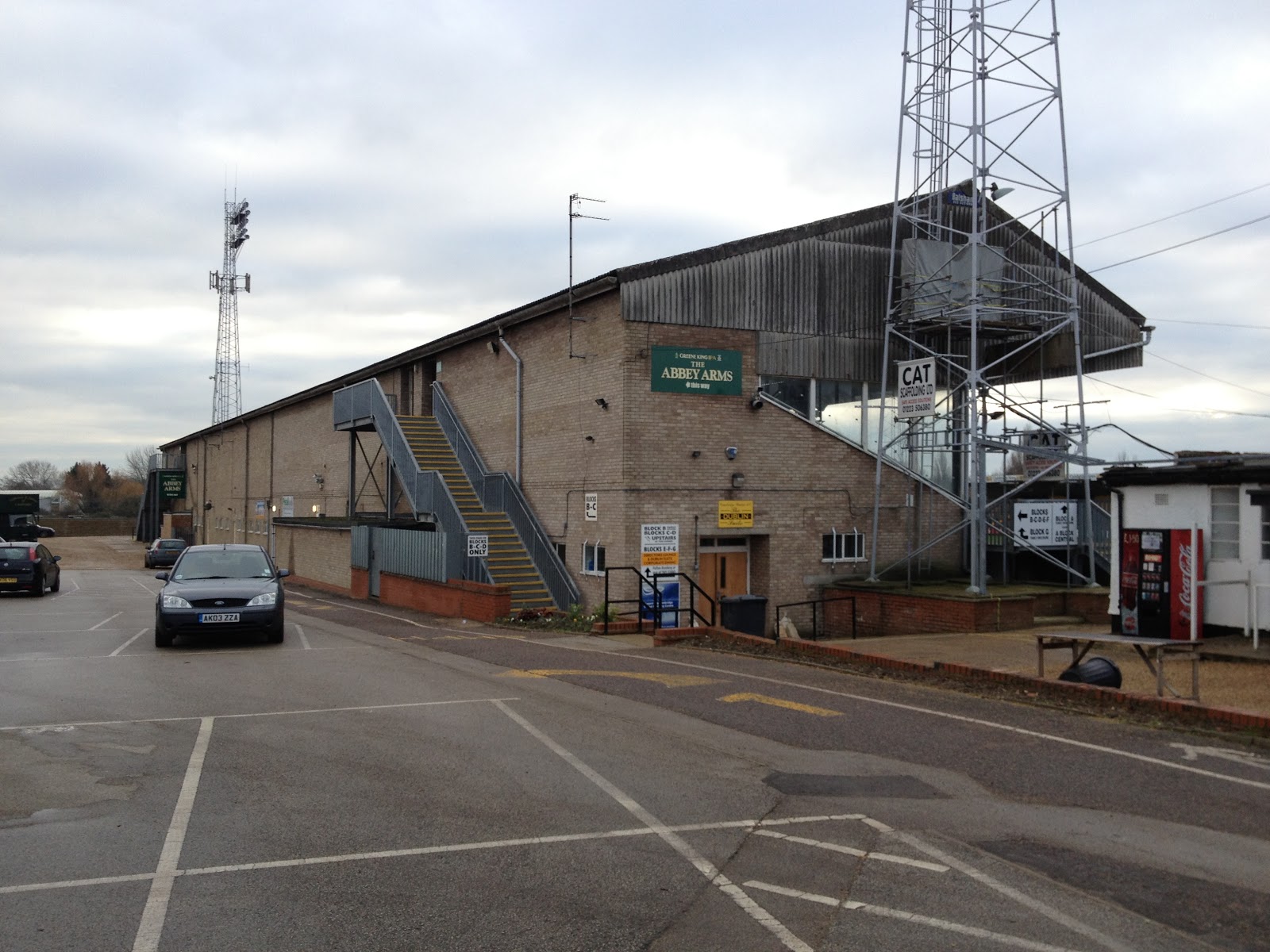
The stadium was the same as my previous visit apart from the far end, where I'd stood seventeen years before. It had been replaced by the South Stand, which was a raised deck of seating. I took my snaps just as the away team arrived by mini bus. I exited the way that they'd come in and found myself by the bus stop for a ride to the town centre, where I was to connect with my service to Histon.


Friday, November 30, 2012

Fortuna Düsseldorf (Germany)


Düsseldorfer Turn- und Sportverein Fortuna 1895 e.V. to give Fortuna Düsseldorf their full title, are a football club from the industrial city of Düsseldorf in Germany's North Rhine-Westphalia region. The club were formed as part of the Turnverein Flingern gymnastics club in 1895, with the team moving to play home games at Lichtplatz from 1908.

Two other local clubs; Düsseldorfer Fußballklub Spielverein who were founded in 1908, and Fortuna (earlier FK Alemania) who were formed in 1911 amalgamated to form Düsseldorfer Fußball-Club Fortuna 1911 in 1913. Another club, TV Flingern joined forces to create Düsseldorfer Turn- und Sportverein Fortuna on 15 November 1919 as the club moved to a new home ground at Vennhauser Straße.


Outside the Espirit Arena

In the 1920's Fortuna began to win honours, picking up four Bezirksliga district titles and providing their first German international player; Ernst Albrecht. In 1930 the club moved grounds once again, this time to Flinger Broich or Fortunaplatz as it was otherwise called in the Flingern district of the city. In 1933 the club were crowned as German champions after winning the national championships and defeating the prominent Schalke 04 in the final in Cologne.

During the period in which the Third Reich were in power, Fortuna were placed in Gauliga Niederrhein, one of sixteen top tier divisions. They were dominant at this level, lifting the title five times as well as being defeated in the national final of 1936 and reaching the Tschammerpokal, which was the predecessor of the DFB Pokal, the following year. The stand out player of that period was Paul Janes, who was the record appearance holder for Germany until 1970.


Paul Janes Stadion
Once back in peacetime the club were placed in Oberliga West, where they were mainly a mid table team having moved across the city to the Rheinstadion in 1953, although they were beaten finalists of the DFB Pokal in 1957, 1958 and 1962. Fortuna were not selected as one of sixteen founder members of the Bundesliga, but they did gain a place after winning promotion three seasons later. However, their spell lasted just one season.

In 1970 Fortuna returned Fortunaplatz for a couple of seasons while the Rheinstadion was rebuilt, as well as winning promotion to the top flight in 1971, for a spell that lasted sixteen years. Third place finished came in the 1972/73 and 1973/74 seasons. The team reached another Pokal in 1978, this time losing to local rivals 1.FC Koln. On the 9th December 1978 Fortuna hammered Bayern Munich 7-1 at the Rheinstadion.

To see Bayern's largest Bundesliga's defeat, go to: http://www.youtube.com/watch?v=Q2AU43uHtn8

The Rheinstadion in its prime
At the end of the 1978-79 season Fortuna reached the European Cup Winners Cup Final, where they lost to FC Barcelona in Berne in a classic encounter. Stand out players at the time were brothers Thomas and Klauss Aloffs, Bernd Zimmermann and Rudi Bommer.

To see the final, click on: http://www.youtube.com/watch?v=iQ7bOOMWzU0

Fortuna were relegated in 1987, but they retiurned two years later for a spell of five seasons. They fought back once again to regain their top tier place between 1995 and 1997, before the club entered a period of turmoil. By 2002 Fortuna found themselves in the fourth tier Oberliga Nordrhein and in huge financial trouble, while playing at the Paul Janes Stadion as Fortunaplatz had been re-named from 1990 in honour of their former hero. The stadium also housed Fortuna Düsseldorf  II. Local punk band Die Toten Hosen helped out by sponsoring the club for a few seasons.


Inside the Espirit Arena

In 2005 Fortuna returned to the site where the new LTU Arena stood in place of the demolished Rheinstadion. In 2008 the club played in the newly formed 3.Bundesliga where they finished as runners-up and won promotion. The 2009-10 season saw the team narrowly miss out on another promotion after finishing in fourth place at the re-named Espirit Arena. After an average following campaign Fortuna started the 2011-12 season in great form, as they headed the table for some time. They eventually won promotion back to the 1.Bundesliga via a play off win over Hertha BSC Berlin. Team captain Andreas Lambertz became the first German player to be promoted three times with the same club.

However, the spell in the top flight lasted just one season as Fortuna were relegated on the final day of the 2012-13 season after defeat to Hannover 96. 

Fortuna Dusseldorf will play in 2. Bundesliga in the 2013-14 season.


My visit

Fortuna Düsseldorf 1 Bayern München 2 (Saturday 14th October 1989) 1.Bundesliga (att: 55,000)


I was on my first ever trip outside the UK with some pals from the Gas Club in Scarborough on a mini holiday in the Rhine Valley. We arrived in Germany on the Friday afternoon, with the coach stopping for an hour or so in Bonn for our driver Derek, to have his designated rest. Naturally enough, without further ado, we headed for a bar.

The establishment we chose had various football mementos hanging up. We managed to get through to the barman that we wanted to know the fixtures for the following day, with this been in the days before the internet and the same coverage that would later be taken as normal. It was established that the game that stood out was Düsseldorf v Munich, with Scottish international Alan McInally getting great reviews back home while starring for Bayern.


I went drinking on the Friday evening with Crusher and Kev Phillips before meeting up with the rest of the gang. Both were very keen on going to the game, so we agreed to make sure we got up and had breakfast to set us on our way. Derek, who wasn't exactly endearing us gave us the advice that we needed to travel south and across the river to Rüdesheim. This needed a costly taxi ride, but we took what he said as gospel. After a couple of liveners at the bar next to the station we got on board our train, only to find out it went via Koblenz, where Derek was taking the rest of the party on a shopping trip!

We arrived a train that got busier with fans as we approached Düsseldorf after our ride that lasted over three hours. We got a few looks as we spoke in English, but the locals were fine once they realised that we weren't Bayern fans. We followed the crowds downstairs to the trams and we were quickly on a packed service to the Rheinstadion.


We managed to work out that we needed tickets in advance, but that was no obstacle. Despite the high attendance, the stadium held 76,000 at the time. We went inside and found ourselves on the terracing behind the goal for 12DM, which was around £4 at the time.

The Rheinstadion was a beautiful venue, although not perfect for football as the pitch was surrounded by an athletics track that had hosted the 1977 World Championships. There was a continuous lower tier with terracing at each end. Above of this tier was a horseshoe shaped upper level, with the far end open. Seating occupied upstairs apart from a couple of blocks at the far end, where the Fortuna fans stood.

Bayern began the game well on top and went ahead after just five minutes through Manfred Schwabl. Much though we were urging on the home side, they doubled their lead on thirty two minutes when Roland Wohlfarth netted.


Me and my new friend
At half time we were chatting away, when a bloke came across with a familiar accent. He turned out to be in the army based nearby, but came from Sheffield and was supporting Bayern. We had a good chat and he gave us some useful tips about the football out there.

Fortuna battled back after the break, but couldn't get a goal back immediately. We wanted to hear the noise if they did. On the hour they did get back into the game via a Klaus Augenthaler own goal. Despite the efforts of Uwe Fuchs leading the home forward line, Bayern held out reasonably comfortably to pick up an away victory.

We let the crowd drift away as we bought a bratwurst and a alcohol free beer and sat in the upper tier seats to get a better view. This allowed us to get on a tram hassle free and even get a seat. We were advised that it was best for us to change trains at Cologne on the way back by the man at the Hauptbanhof. While we were waiting for it to come along a special train full of Bayern fans went past us. I was wearing a Fortuna hat, and received dogs abuse, much to the hilarity of my pals.


We did change at Cologne, and lo and behold we caught a direct train to St Goar, where we were based. A couple of hours later we were sat in the pub having a meal and watching the highlights while drinking away. It was as well Derek didn't feel thirsty, as we ready to offer him major feedback!


The pictures at the top of this page of The Espirit Arena, Rheinstadion and Paul Janes Stadion have been taken from the internet. They will be replaced, hopefully soon, when I return for a game.


KFC Uerdingen 05 (Germany)


KFC Uerdingen 05 (Krefelder Fußballclub Uerdingen 05 e.V., to give them their full title) are a football club in the district of Uerdingen in the 'velvet and silk' city of Krefeld in Germany's North Rhine-Westphalia. The club was formed on the 17th November 1905 as Fußball-Club Uerdingen 05, until August 1919 when they were joined by Sportvereinigung des Realgymnasiums Urdingen. In 1927 the club moved into the newly constructed Grotenburg-Stadion.


During World War II the club joined forces with VfB 1910 Uerdingen, playing as Kriegspielgemeinschaft Uerdingen. In peacetime they continued their alliance as Spielvereinigung Uerdingen 05, until February 1948 when VfB became an independant club once more. In 1950 SpVgg returned to their original name of FC Uerdingen 05.


1953 saw another merger with Werkssportgruppe Bayer AG Uerdingen, the works team of the chemical giants Bayer AG, taking the name FC Bayer 05 Uerdingen. Having played their football at local amateur level, the club progressed to Amateurliga Niederrhein in the early 60's. Further progression came in 1971 as Uerdingen reached Regionalliga West. After a few seasons of strong finishes, they ended the 1974-75 season as runners-up, which led to promotion to the Bundesliga as their home stadium was renovated to hold the bigger crowds.


The historical logos of the club

Their spell in the top flight lasted just one season, before they were relegated to 2.Bundesliga Nord. A second place finish in 1979 saw Uerdingen promoted once again; this time for a period of two years. They were obviously not satisfied with second tier football as the club were promoted once more in 1983, to start the clubs most successful period.


In 1986 Bayer Uerdingen finished in third place in the Bundesliga and also winning the DFB Pokal (German Cup) in 1985 after beating Bayern Munich 2-1 in the final at Berlin's Olympiastadion.

To see action of the great day, go to: http://www.youtube.com/watch?v=9iMgSVL90Ng

The following season saw the club in European Cup Winners Cup action, with the quarter final seeing one of the most dramatic games in UEFA history. By half time in the second leg at the Grotenburg-Stadion Uerdingen were 5-1 down on aggregate to Dynamo Dresden. The final fourty five minutes saw the home side hammer in six unanswered goal to win the tie 7-5 over the two games, before losing to Atletico Madrid in the semi-final.

To see the dramatic Dynamo second leg, go to: http://www.youtube.com/watch?v=aQ9aVIkUPLg


Following these successes the Grotenburg was given further refurbishments, and all seemed well despite a few promotions and relegations between the top flight and 2.Bundesliga and winning the Intertoto Cup on four occasions, until 1995 when Bayer withdrew their funding. The club started their 1995-96 Bundesliga campaign as Krefelder Fußball-Club Uerdingen 05 in the Bundesliga, before two relegations saw the club plying their trade in the third tier Regionalliga Nord by the turn of the millennium.

Worse was to follow in 2003 as the DFB refused the club a license to compete at that level owing to financial problems. Instead KFC were placed in Oberliga Nordrhein. The German leagues were restructured for the 2008-09 season with the introduction of 3.Bundesliga. Uerdingen hoped for a place in the fourth tier Regionalliga under the stewardship of veteran coach and Fortuna Düsseldorf legend Aleksandar Ristić for a short spell.


Instead, the club were placed in the Verbandsliga. In 2010-11 Uerdingen won their first promotion in seventeen years as they lifted the Verbandsliga title and a place in the NRW-Liga. When this league was disbanded, KFC were placed in Oberliga Niederrhein as the club tried to raise finances with some inavative ideas to assist in their push back up the leagues, including a friendly with Bayern Munich which drew a crowd of 30,000 for a friendly.

KFC Uerdingen 05 played in the Oberliga Niederrhein in the 2012-13 season and went on to win the title, gaining promotion back to the Regionalliga.

KFC Uerdingen 05 will play in the Regionalliga West in the 2013-14 season.


My visit

Saturday 27th October 2012

I awoke in my Dusseldorf hotel on a beautiful bright late autumn morning after a really good first day in Germany in my search of new stadiums and football. The previous nights 3-3 draw in Cologne, followed by a really good drink in Dusseldorf's Aldstadt had put me in a really good mood, as well as helping me to a much needed deep sleep.

My afternoon destination was Gelsenkirchen for the clash between Schalke and Nuremburg, but I was determined not to waste my morning. I remember Bayer Uerdingen from my youth and had since done some research as to their demise. Their website showed a good old fashioned stadium, and I wanted to see it in the flesh.


After a quick train from my adjacent station to Dusseldorf's Hauptbanhof, I was soon on a train via Neuss which would stop at the Krefeld-Oppum station. After a twenty minute ride I was out in the cool air and taking a ten minutes brisk walk up Buddestrasse past the tram stop and pretty Schonwasserpark and into the busy main Berliner Strasse. This took me past the zoo and to the stadium.

The road up to the stands took me past the wonderful sight of hundreds of kids practising on artificial pitches in the hope of becoming the next local hero, as their doting parents looked on. I was even happier on finding the gates in the corner to the stadium open. What I found was a ground I grew up going to games in. It was a real beauty.

The North Stand was a large covered single tiered block of seats. Opposite was the South Strand, which backed onto the training ground, with a seating tier behind a large terraced paddock. The West Terrace was a huge open end up to the pitch with a scoreboard at the rear. These three constructions had all been built after the successes of the Cup Winners Cup. The final East Terrace was the original which was curved away from the pitch, where the athletics track once ran.


I wandered along the back of the South Stand, where a drinks kiosk was open for spectators watching the youngsters going through their drills. Everyone seemed friendly, with a few allo's and smiles being exchanged. I gained access into the West Terrace, which was showing signs of not being used for some time. The stadium car park was being used for a car boot stall come flea market, so I had a look at the stalls to see if anything took my interest before heading back to the station.

Having a few minutes to kill, I took the opportunity to pop into a local bakery, where the friendly staff spoke perfect English on seeing me struggle with my pidgin German. The large Danish pastry and strong coffee were most welcoming. At this point I made a decision after a bit of quandering and took a train into Krefeld, where I hoped to get a fast train towards Duisburg in the hope that time would be a kind enough to allow me the opportunity of visiting the Schauinsland-Reisen-Arena. The trains were fine as I'd planned, but the stadium was too far from the station. I couldn't really complain.


I'd visited a lovely city, albeit briefly and seen a tremendous traditional stadium with youths playing the game. I knew for certain that one day in the future that I wanted to attend a KFC Uerdingen 05, preferably with the club doing well.